Telescopes

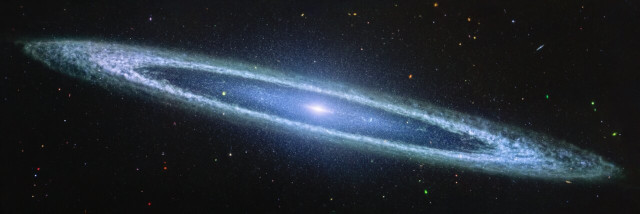
The Sombrero Galaxy as seen in infrared by the James Webb Space Telescope

A new image (NASA, ESA, CSA, STScI) captured by the James Webb Space Telescope depicts the Sombrero Galaxy in infrared. The MIRI (Mid-Infrared Instrument) instrument offers details invisible to other telescopes, creating a portrait different from what astronomers are used to. The nucleus is very bright at visible light frequencies while in infrared a smooth inner disk is revealed. The outer disk is “clumpy” and this allows to understand the distribution of dust inside it, an important result to get an idea of ​​the ongoing star formation processes.

The WOH G64 star seen from the VLTI (ESO Image/K. Ohnaka et al.)

An article published in the journal “Astronomy & Astrophysics” reports the creation of a detailed image of the red supergiant star WOH G64 and its surroundings, the first ever obtained of a star outside the Milky Way. A team of researchers led by astrophysicist Keiichi Ohnaka of the Universidad Andrés Bello, Chile, used the GRAVITY instrument on ESO’s VLTI in Chile to obtain details of this star in the Large Magellanic Cloud. This study may provide important insights into a star that is going through the death throes that will end with its explosion as a supernova. A dust cocoon and a possible torus surrounding WOH G64 show signs of that death throes.

The ultramassive galaxies S1, S2, and S3

An article published in the journal “Nature” reports the discovery of three ultramassive galaxies in the early universe in which stars are forming with an efficiency almost twice that of galaxies of average mass by the standards of that era. A team of researchers coordinated by the University of Geneva (UNIGE) used observations conducted with the James Webb space telescope within the FRESCO program. The three galaxies (Image NASA/CSA/ESA, M. Xiao & P. ​​A. Oesch (University of Geneva), G. Brammer (Niels Bohr Institute), Dawn JWST Archive), which were cataloged as S1, S2, and S3, are almost as massive as the Milky Way and add to others that were discovered in recent years and are difficult to explain with the most accepted cosmological models, starting with lambda-CDM.

Protogalaxies as seen by the James Webb Space Telescope (Image NASA)

An article published in “The Astrophysical Journal” reports some predictions offered by MOND (Modified Newtonian Dynamics), a theory based on modifications to Newton and Einstein’s gravitational laws that doesn’t include the existence of dark matter. Stacy S. McGaugh, James M. Schombert, Federico Lelli, and Jay Franck have applied this model to primordial galaxies studied with the James Webb Space Telescope obtaining a better agreement than the lambda-CDM model, the best cosmological model based on the existence of dark matter. This is one of the studies, often based on Webb’s observations, that are testing cosmological models that weren’t considered very much due to the lack of confirmation.

Artist's concept of a primordial dwarf galaxy with a fast growing supermassive black hole (Image NOIRLab/NSF/AURA/J. da Silva/M. Zamani)

An article published in the journal “Nature Astronomy” reports the results of the study of the dwarf galaxy cataloged as LID-568, which has at its center a supermassive black hole that is devouring materials at a rate that is more than 40 times faster than its theoretical limits. A team of researchers led by astronomer Hyewon Suh of the International Gemini Observatory/NSF NOIRLab combined observations conducted with the Chandra and James Webb space telescopes to obtain precise data on this voracious supermassive black hole. We see it as it was about 1.5 billion years after the Big Bang and its discovery indicates a way in which these very extreme objects manage to grow so quickly.