Telescopes

Artist’s Impression of a Hot Jupiter Progenitor with its star in the background (Image NOIRLab/NSF/AURA/J. da Silva (Spaceengine))

An article published in the journal “Nature” reports a study on the exoplanet cataloged as TIC 241249530 b which labels it as a progenitor of a hot Jupiter. A team of researchers used various telescopes to study TIC 241249530 b and try to understand its characteristics and evolution. This gas giant has an extremely eccentric orbit, meaning it’s extremely elongated, which could change greatly as time passes.

Observations and simulations suggest that the star’s gravitational action will drive this planet to have an almost circular orbit close to the star itself. This led the researchers to conclude that TIC 241249530 b is in the first phase of a planetary migration. The star is slightly more massive than the Sun and has an age estimated at just over three billion years, which indicates that these processes can begin well after the formation of a planetary system.

The Einstein ring cataloged as PJ0116-24 (Image ALMA (ESO/NAOJ/NRAO)/ESO/D. Liu et al.)

An article published in the journal “Nature Astronomy” reports the results of a study of the Hyper Luminous Infrared Galaxy (HyLIRG) cataloged as PJ0116-24 which offers some surprises about this type of galaxy. A team of researchers combined observations conducted with the ALMA radio telescope and the Enhanced Resolution Imager and Spectrograph (ERIS) instrument mounted on ESO’s VLT to obtain details of PJ0116-24.

The complication in the study comes from the fact that it’s about 10 billion light-years away from Earth and is visible thanks to a gravitational lensing effect that makes it appear like a so-called Einstein ring, a name due to the fact that it’s a result predicted by the theory of general relativity. The surprise is due to the fact that the researchers expected to find traces of a galaxy merger while the details indicate that it’s an orderly galaxy although very active in star formation.

From the left, the globular cluster Omega Centauri, its central area, and the area where the intermediate-mass black hole is probably located

An article published in the journal “Nature” reports evidence that the globular cluster Omega Centauri contains an intermediate-mass black hole. A team of researchers led by Maximilian Häberle of the Max Planck Institute for Astronomy (MPIA) in Heidelberg, Germany, used two decades of observations conducted with the Hubble Space Telescope to find that evidence. They did this by tracing the orbit of seven stars at the center of Omega Centauri that are moving fast due to an object with a mass that is at least 8,200 times the Sun’s. This also confirms the hypothesis that this star cluster is what remains of a dwarf galaxy absorbed by the Milky Way.

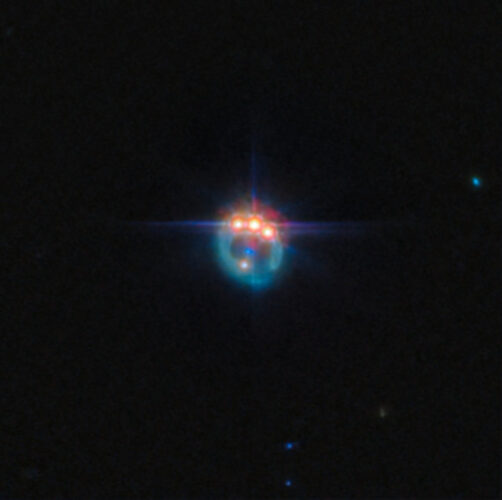
The quasar cataloged as RX J1131-1231, or simply RX J1131 (Image ESA/Webb, NASA & CSA, A. Nierenberg)

A new image captured by the James Webb Space Telescope depicts the quasar cataloged as RX J1131-1231, or simply RX J1131. About six billion light-years away from Earth, it’s visible in three different copies, recognizable in the upper part of the bright ring in the center of the image, due to a gravitational lensing effect generated by a galaxy between it and Earth. In particular, MIRI (Mid-Infrared Instrument) was used to observe RX J1131 with different mid-infrared filters as part of an observation program that studies dark matter.

The protostar forming within the L1527 molecular cloud observed by the James Webb Space Telescope's MIRI instrument

A new image captured by the James Webb Space Telescope reveals new details of a protostar forming within the molecular cloud cataloged as L1527. The MIRI instrument offered new information on the ongoing processes that are leading to the birth of a new star. An accretion disk is barely visible edge-on and is important because the protostar is still absorbing materials from it and planets could form within it in the future. During its formation, the protostar emits jets of gas that collide with the remains of the surrounding cloud, generating the structures MIRI sees in a color that is blue in the top image (NASA, ESA, CSA, STScI) thanks to the presence of polycyclic aromatic hydrocarbons (PAHs), compounds that are common in space.