Telescopes

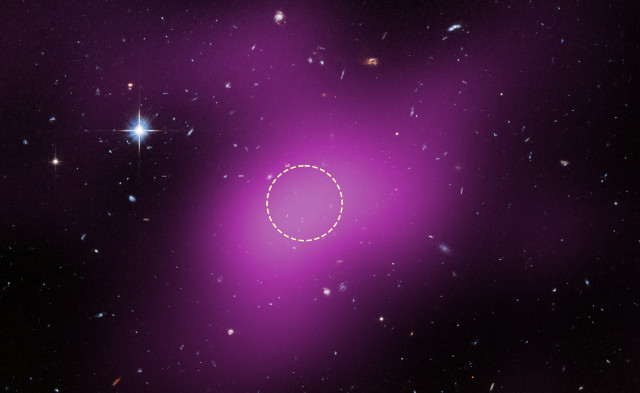
The location of Cloud-9 (Image NASA, ESA. G. Anand (STScI), and A. Benitez-Llambay (Univ. of Milan-Bicocca); Image processing: J. DePasquale (STScI))

An article published in “The Astrophysical Journal Letters” reports the discovery of what was dubbed Cloud-9, which can be described as a failed galaxy. A team of astronomers used observations with the FAST radio telescope to identify what appears to be a new type of astronomical object, and follow-up observations with the Hubble Space Telescope, the Green Bank Telescope (GBT), and the Very Large Array (VLA) to confirm the existence of the first object of its kind that was identified with reasonable certainty.

Technically defined as a reionization-limited H i cloud (RELHIC), Cloud-9 is a starless gas cloud that is supposed to be composed of dark matter filled with hydrostatic gas in thermal equilibrium with the cosmic ultraviolet background. Cloud-9 will help test cosmological models regarding dark matter.

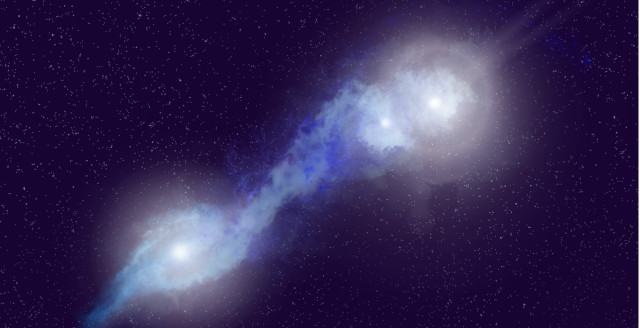
Artist's impression of the J1218/1219+1035 system (Image NSF/AUI/NSF NRAO/P. Vosteen)

A rare example of three active galactic nuclei in three merging galaxies has been discovered using two radio telescopes: the VLA and the VLBA. The triple system, approximately 1.2 billion light-years from Earth, is cataloged as J1218/1219+1035. This targeted study, conducted by a team of researchers at various radio frequencies, has identified only the third case of a triple active galactic nucleus, the first confirmed through radio observations. This discovery is useful for better understanding certain galaxy merger processes, such as the ones that led to the formation of the Milky Way.

The complete map obtained thanks to the SPHEREx space telescope, with infrared emissions generated mainly by dust (red) and hot gas (blue), key ingredients in the formation of new stars and planets

NASA has published the first cosmic map generated using observations from its SPHEREx space telescope. In particular, these observations include 102 wavelengths in the near-infrared. What NASA has defined as 102 colors offer a wealth of different information about the observed objects, valuable in a variety of cosmological studies. The wealth of information is such that NASA treats them as if they had obtained 102 different maps.

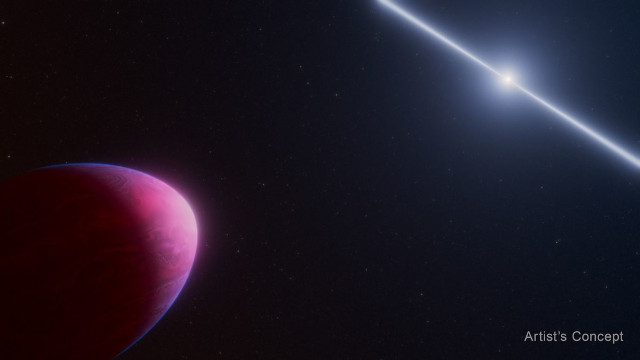
Artist's concept of the of the exoplanet PSR J2322-2650b and its pulsar (Image NASA, ESA, CSA, Ralf Crawford (STScI))

An article published in The Astrophysical Journal Letters reports the results of a study of a gas giant exoplanet cataloged as PSR J2322-2650b, which has a completely abnormal atmosphere composed above all of helium and carbon. A team of researchers used observations conducted with the James Webb Space Telescope to study the atmosphere of this exoplanet, which has a mass similar to Jupiter’s and has a distance from its star that is only one-hundredth of the Earth’s distance from the Sun. The star is a pulsar, adding another unusual element to the system. PSR J2322-2650b can’t be explained by current models of planetary formation.

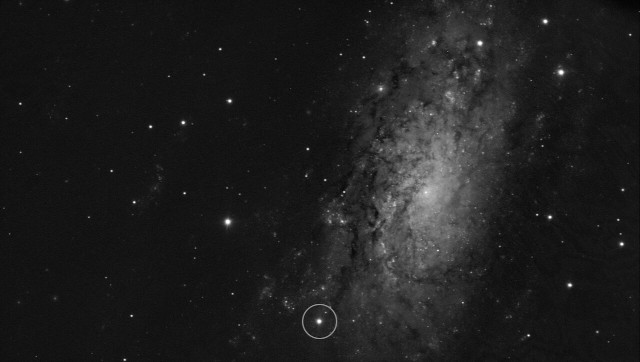
Galaxy NGC 3621 with the location of supernova SN 2024ggi in the small circle

An article published in the journal “Science Advances” reports the first reconstruction ever of the shape of a Type II supernova in its early stages. A team of researchers led by Professor Yi Yang of Tsinghua University in Beijing, China, used observations conducted with ESO’s Very Large Telescope (VLT) in Chile to study the supernova cataloged as SN 2024ggi on April 11, 2024, the day after the explosion began.