
Telescopes

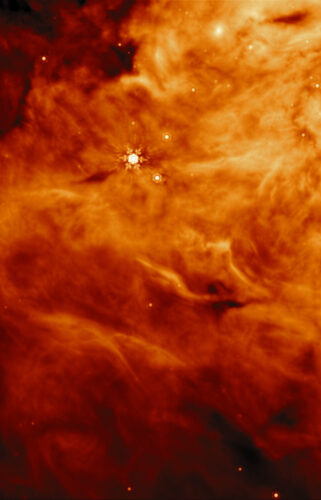
A region of a molecular cloud (Image ESA/Webb, NASA, CSA, W. Rocha et al. (Leiden University))

An article published in the journal “Astronomy & Astrophysics” reports the discovery of various complex organic molecules such as ethanol among the icy materials surrounding two protostars. A team of researchers used the James Webb Space Telescope’s Mid-Infrared Instrument (MIRI) to identify icy organic compounds around the low-mass protostar NGC 1333 IRAS 2A, or simply IRAS 2A, and the high-mass protostar IRAS 23385+ 6053, or simply IRAS 23385. Various molecules constitute building blocks for Earth-like life forms that could be like “seeds” on planets still in the process of formation.

Some of the systems observed with the VLT and represented here not in scale to appear similar in size

Three articles published in the journal “Astronomy & Astrophysics” report different aspects of a large study of 86 protoplanetary disks located in three different regions of the Milky Way. Teams of researchers with several shared members used the SPHERE instrument mounted on ESO’s Very Large Telescope (VLT) in Chile as part of the GTO and DESTINYS observation programs. The findings offer a treasure trove of information about planetary formation in the cosmic neighborhood that could lead to advances in current models and aid follow-up studies.

Una porzione di cielo fotografata dallo strumento NIRCam del telescopio spaziale James Webb con la galassia GN-z11 nel riquadro

Two articles, one published in the journal “Nature” and one accepted for publication in the journal “Astronomy & Astrophysics”, report different aspects of a study of the galaxy GN-z11, one of the most distant known, which revealed the presence of the most distant and ancient black hole found so far. A team of researchers led by Roberto Maiolino of the University of Cambridge used the James Webb Space Telescope to examine GN-z11 finding traces of the activity of the supermassive black hole at its center. Those traces indicate that it’s devouring surrounding materials at a remarkable speed. Spectroscopic analyzes showed the presence of a clump of helium in the halo surrounding GN-z11 and no heavy elements, suggesting that first-generation stars may form in that halo.

Artist’s impression of the white dwarf WD 0816-310 with its magnetic field and the debris that surrounds it (Image ESO/L. Calçada)

An article published in “The Astrophysical Journal Letters” reports the results of a study of the white dwarf cataloged as WD 0816-310 and of what was defined as a scar on its surface, left by the materials of a large asteroid that got swallowed. A team of researchers used ESO’s VLT (Very Large Telescope) in Chile to obtain the information necessary to identify the metallic elements that form that scar and its concentration in a specific area, which is one of its magnetic poles. This result offers new insights into the evolution of planetary systems after the death of their star.

The remnant of the supernova SN 1987A as seen by the James Webb Space Telescope

An article published in the journal “Science” reports new evidence that the supernova SN 1987A generated a pulsar. A team of researchers used observations conducted with the James Webb Space Telescope to detect the effects of high-energy emissions coming from the pulsar or the pulsar wind nebula, a nebula that surrounds it and is powered by the pulsar. These are confirmations of conclusions reached by other teams of researchers in recent years using observations in other electromagnetic bands.