Telescopes

LEDA 60847 (Image NASA/ESA/A. Barth (University of California - Irvine)/M. Koss (Eureka Scientific Inc.)/A. Robinson (Rochester Institute of Technology)/Processing: Gladys Kober (NASA/Catholic University of America))

An image captured by the Hubble Space Telescope shows LEDA 60847, a group of interacting galaxies. The largest galaxy has an active galactic nucleus (AGN) with a supermassive black hole surrounded by materials that are heated to the point of generating the electromagnetic emissions behind its luminosity. This galaxy is interacting with its neighbors and in a very long time, they will form a single larger galaxy.

The N79 South molecular complex (Image ESA/Webb, NASA & CSA, O. Nayak, M. Meixner)

An image captured by the James Webb Space Telescope shows a part of the star-forming region cataloged as N79 in the Large Magellanic Cloud, one of the Milky Way’s satellite dwarf galaxies. It’s considered a sort of younger version of the Tarantula Nebula but astronomers believe that its star formation has been twice as efficient over the last 500,000 years. The Mid-InfraRed Instrument (MIRI) was used to capture never-before-seen mid-infrared details of N79 that will be invaluable in improving our understanding of star formation processes.

Artist's impression of the compact object in the black hole mass gap with the NGC 1851E pulsar at the top (Image courtesy Daniëlle Futselaar (artsource.nl))

An article published in the journal “Science” reports the discovery of a compact object within the globular cluster cataloged as NGC 1851 whose nature is uncertain because mass estimates place it on the border between a neutron star and a black hole. A team of researchers used observations conducted with the MeerKAT radio telescope to identify traces of a binary system composed of a so-called millisecond pulsar and the mysterious compact object. The estimated mass for this object is between 2.09 and 2.71 times the Sun’s, so it could be a massive neutron star or a small black hole.

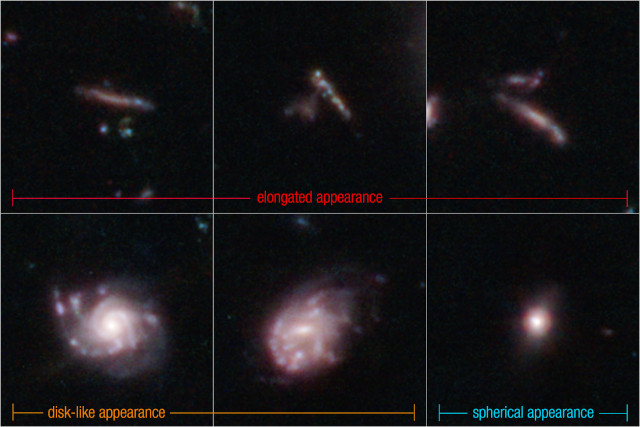
Some examples of the galaxies observed during the Cosmic Evolution Early Release Science (CEERS) survey

An article in publication in “The Astrophysical Journal” reports the results of observations of early galaxies that show strange shapes, decidedly different from the ones we’re used to and compared to bananas and even breadsticks. A team of researchers led by Viraj Pandya of Columbia University used observations conducted with the James Webb Space Telescope as part of the CEERS survey from which they obtained images of galaxies dating back to a period between 600 million and 6 billion years after the Big Bang.

Illustration of the HD 63433 star system

An article published in “The Astronomical Journal” reports confirmation of the existence of the exoplanet HD 63433d, a rocky planet with a size close to the Earth’s that orbits a star very similar to the Sun in a system that was already known. A team of researchers led by Melinda Soares-Furtado of the University of Wisconsin-Madison and Benjamin Capistrant, now a student at the University of Florida, used data collected by NASA’s TESS space telescope to identify HD 63433d within the THYME (TESS Hunt for Young and Maturing Exoplanets) survey. Its close proximity to its star probably makes it a so-called lava planet since on the dayside, the temperature on its surface is estimated at over 1,500° Kelvin.