Telescopes

The Cassiopeia A supernova remnant

An image of the Cassiopeia A supernova remnant (NASA, ESA, CSA, STScI, Danny Milisavljevic (Purdue University), Ilse De Looze (UGent), Tea Temim (Princeton University)), or simply Cas A, captured by the James Webb Space Telescope’ NIRCam instrument shows new details of the structures present among the materials surrounding what remains of the progenitor star. In April 2023, images captured by another Webb instrument, MIRI, were published, showing different details of Cassiopeia A. The reasons why certain structures are invisible to NIRCam are also being studied.

The central area of the Milky Way as seen by the Subaru telescope. Several stars are visible in an area about 0.4 light-years across. The star S0-6 is circled in blue while the area where the supermassive black hole Sagittarius A* is located is circled in green.

An article published in the journal “Proceedings of the Japan Academy, Series B, Physical and Biological Sciences” reports a study on the star cataloged as S0-6 which indicates that it formed in another galaxy and only over time reached the center of the Milky Way. Since 2014, a team of researchers led by Shogo Nishiyama of Miyagi University of Education in Japan has been studying various stars that now orbit Sagittarius A*, or simply Sgr A*, the supermassive black hole at the center of the Milky Way.

The AzTECC71 galaxy (Image J. McKinney/M. Franco/C. Casey/The University of Texas at Austin)

An article published in “The Astrophysical Journal” reports a study on AzTECC71, what appears to be a dusty primordial galaxy in which remarkable star formation is taking place. A team of researchers from the COSMOS-Web collaboration led by Jed McKinney of the University of Texas at Austin observed what appeared to be a ghost galaxy with the James Webb Space Telescope. The peculiarity of this study is that AzTECC71 was detected by some ground-based telescopes but didn’t appear to the Hubble Space Telescope. This may be a much more common case than previously thought that requires some sort of ghostbuster to find.

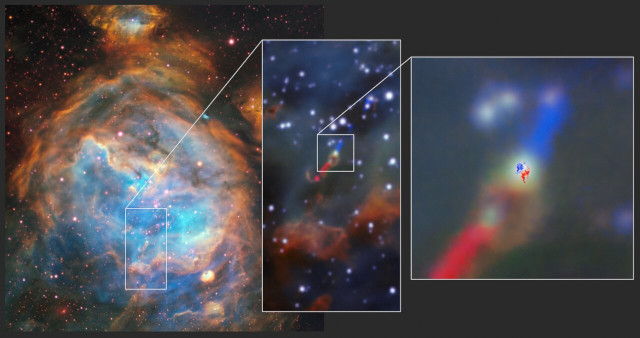
The HH 1177 system

An article published in the journal “Nature” reports the identification of a protoplanetary disk around the very young star cataloged as HH 1177 in the Large Magellanic Cloud, one of the dwarf galaxies satellite of the Milky Way. A team of researchers used the ALMA radio telescope to observe the disk in a follow-up study after observations conducted with the MUSE instrument mounted on the VLT allowed to see jets coming from the still-forming star. This is the first detection of a circumstellar disk in another galaxy. That type of structure is also called a Keplerian disk in jargon because it obeys the same laws as planetary motion.

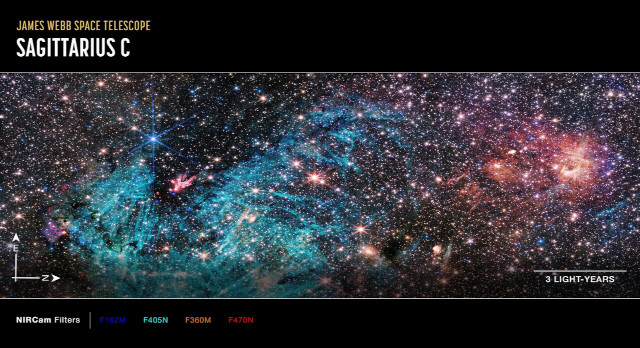
The area cataloged as Sagittarius C

An image captured with the James Webb Space Telescope shows a star-forming area cataloged as Sagittarius C just 300 light-years away from Sagittarius A*, the supermassive black hole at the center of the Milky Way. In the heart of the galaxy, among half a million stars, there’s a cluster of protostars in the middle of a cloud so dense that the stars behind it are obscured even to the most powerful existing telescope. In contrast, protostars are visible to the NIRCam instrument in detail along with cosmic features that were previously unknown and astronomers have yet to identify.