
Telescopes

Artist's concept of the TOI-4600 system (Image courtesy Tedi Vick)

An article published in the “Astrophysical Journal Letters” reports the discovery of two exoplanets orbiting the star TOI-4600 of which the outermost is the one with the longest year discovered so far. A team of researchers used observations conducted with NASA’s TESS space telescope to find traces of these two gas exoplanets. Other ground-based observatories were used to confirm the existence of these two exoplanets and obtain more information about them. TOI-4600 b has a year of nearly 83 Earth days, a bit shorter than Mercury’s, while TOI-4600 c has a year of nearly 483 days, the longest of all known exoplanets. This is a useful discovery to understand what other planetary systems are like because exoplanets close to their stars are much easier to discover while we still know very little about the ones far from their stars.

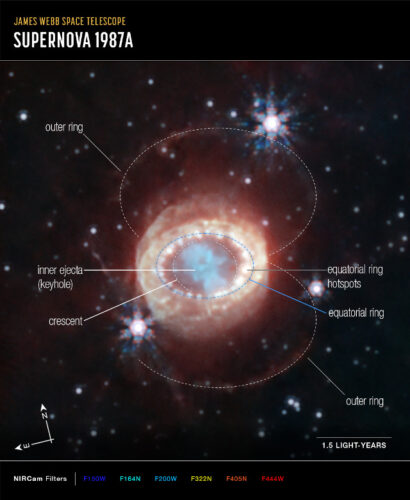
SN 1987A as seen by the James Webb Space Telescope's NIRCam (Near-Infrared Camera) instrument

An image of the remnants of supernova 1987A (SN 1987A) captured by the James Webb Space Telescope caught new details and never-before-seen structures such as the central one, which has a shape like a keyhole, and near it crescent-shaped formations. The NIRCam instrument proves again that it can see where other instruments have seen little or nothing in the decades since the supernova was detected. The aim is always to understand what happens in the years following a supernova to what remains of the star that exploded and to the materials ejected into interstellar space.

International Gemini Observatory/NOIRLab/NSF/AURA/P. Marenfeld QuasarPōniuāena

An article published in “The Astrophysical Journal Letters” reports the discovery of the most distant cold molecular gas in the interstellar medium of the galaxy that hosts the quasar nicknamed Pōniuāʻena, one of the three most distant bright quasars known. A team of researchers led by some associates of the Italian National Institute of Astrophysics (INAF) used observations conducted with the NOEMA (Northern Extended Millimeter Array) radio telescope to obtain the detection of the gas, to be precise carbon monoxide. This study can provide valuable information to understand how a supermassive black hole could have a mass 1.5 billion times the Sun’s when the universe was “only” 700 million years old.

The Ring Nebula as seen by MIRI (Image ESA/Webb, NASA, CSA, M. Barlow, N. Cox, R. Wesson)

Just a couple of weeks after the publication of an image of the Ring Nebula, one of the most iconic planetary nebulae, captured by the James Webb Space Telescope’s NIRCam instrument, another image arrived, this time, captured by the MIRI instrument. Several filters were used to capture the emissions at various wavelengths in the mid-infrared to offer details that complement those offered by the NIRCam. The new details also indicate the presence of various compounds and about ten concentric arcs just beyond the outer edge of the main ring. These new results offer new insights into the processes taking place in the last stages of a star’s life and, in this case, the interaction with a possible companion.

Artist's concept of the HD 45166 system with the helium star in the foreground (Image ESO/L. Calçada)

An article published in the journal “Science” reports a study that identifies one of the stars in the binary system HD 45166 as the likely precursor of a magnetar. A team of researchers led by Tomer Shenar of the University of Amsterdam used various telescopes to study a so-called helium star, a massive star that is nearing the end of its life and has already ejected its outer layers and is left with a core formed by helium on its surface. This star revealed an extremely powerful magnetic field, estimated to be about 100,000 times the Earth’s.