Telescopes

An article published in the journal “Nature Astronomy” reports the discovery of a binary system that includes a white dwarf pulsar, the second such object discovered so far. A team of researchers that includes some of those who discovered the first white dwarf pulsar identified J191213.72-441045.1, or simply J1912-4410, a binary system that also includes a normal star belonging to the red dwarf class. This new discovery offers new insight into what constitutes a new class of cosmic objects with the potential to develop models to describe their formation and behavior.

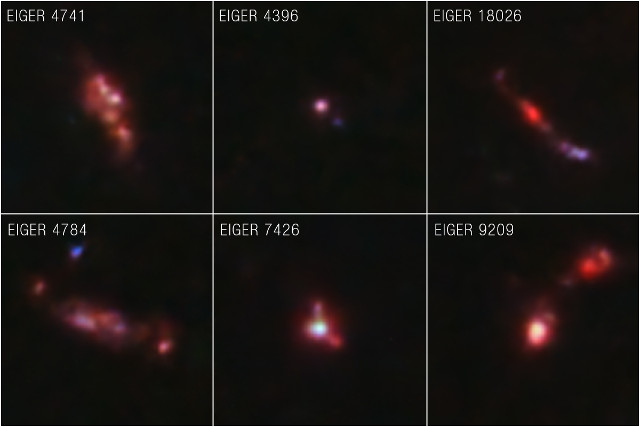
Some galaxies observed in this study, which we see as they were when the universe was 900 million years old

Three articles published in “The Astrophysical Journal” report various aspects of a study on the epoch of reionization and bring evidence that the first galaxies transformed the universe from an opaque place to the current place where light can spread. Researchers from the EIGER team led by Simon Lilly of the ETH Zurich, Switzerland, used the James Webb Space Telescope together with some ground-based telescopes to observe primordial galaxies finding transparent regions around them thanks to the reionization of the gas.

Image that celebrates the discovery of the exoplanet BEBOP-1 c (Image courtesy Amanda Smith / University of Birmingham)

An article published in the journal “Nature Astronomy” reports the discovery of a second circumbinary planet that orbits the two stars that form the BEBOP-1 system. A team of researchers used the HARPS and ESPRESSO spectrographs to find for the first time a circumbinary planet using the radial velocity method. This exoplanet, cataloged as BEBOP-1 c, joins TOI-1338 b, discovered in 2020 thanks to NASA’s TESS space telescope. Estimates indicate that BEBOP-1 c is a gas giant with a mass around 65 times the Earth’s and a year lasting about 215 Earth days.

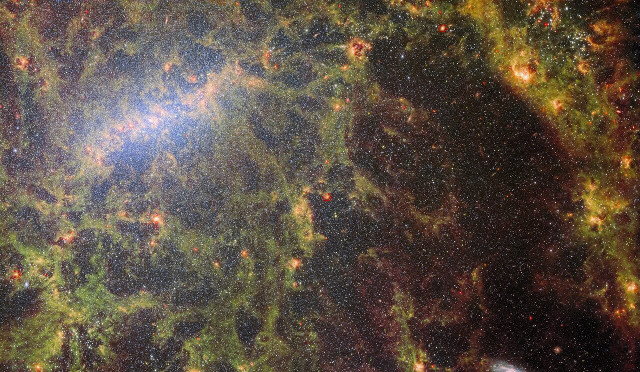
A part of the galaxy NGC 5068 as seen by the James Webb Space Telescope (Image ESA/Webb, NASA & CSA, J. Lee and the PHANGS-JWST Team)

An image captured by the James Webb Space Telescope shows the core and part of a spiral arm of the galaxy NGC 5068. Two instruments, MIRI and NIRCam, were used to examine this barred spiral galaxy, and the various infrared filters allowed to detect an enormous amount of detail among dusty structures and star-forming areas where there are newborn stars still surrounded by shells of gas and dust.

About 20 million light-years from Earth, the galaxy NGC 5068 belongs to the most common class in the universe, spiral galaxies. The presence of a star formation extending from the core in a shape resembling a bar places it in the subclass of the barred spiral galaxies, which probably make up about two-thirds of their class.

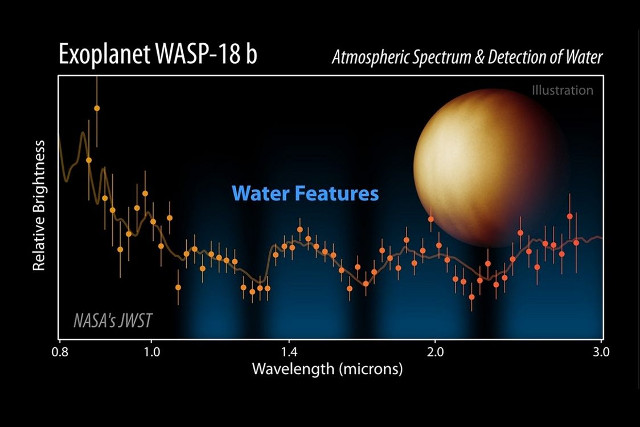
An artist's impression of the exoplanet WASP-18b and the spectrum of thermal emissions detected by the James Webb Space Telescope's NIRISS instrument at wavelengths between 0.85 and 2.8 microns

An article published in the journal “Nature” reports the results of an examination of the exoplanet WASP-18b. A team of researchers used the James Webb Space Telescope to map the temperatures on the surface of this ultra-hot Jupiter very close to its star. The temperature variations are around 1,000° Kelvin between the hottest area always facing its star and the border area between day and night. Webb’s Near-Infrared Imager and Slitless Spectrograph (NIRISS) also found traces of water vapor that other instruments had missed.