Telescopes

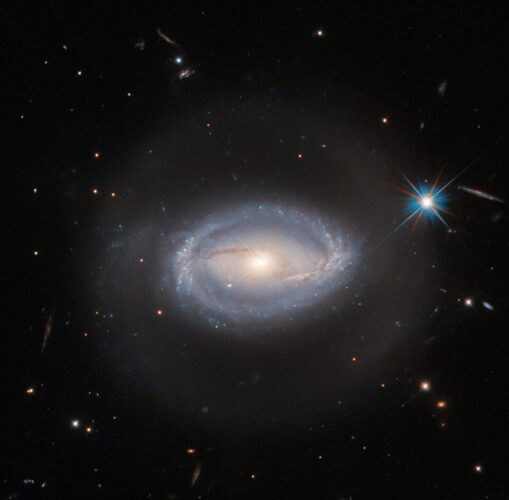
Galaxy Z 229-15 (Image ESA/Hubble & NASA, A. Barth, R. Mushotzky)

An image captured by the Hubble Space Telescope shows galaxy Z 229-15. A combination of the Advanced Camera for Surveys (ACS) and Wide Field Camera 3 (WFC3) instruments with three different filters was used to obtain observations including ultraviolet, optical, and near-infrared emissions. Z 229-15 is a galaxy that defies simple classification criteria because it has a set of features not normally found together. The result is that it fits different definitions showing how sometimes classes and subclasses of galaxies don’t have precise boundaries but can overlap making different classifications valid.

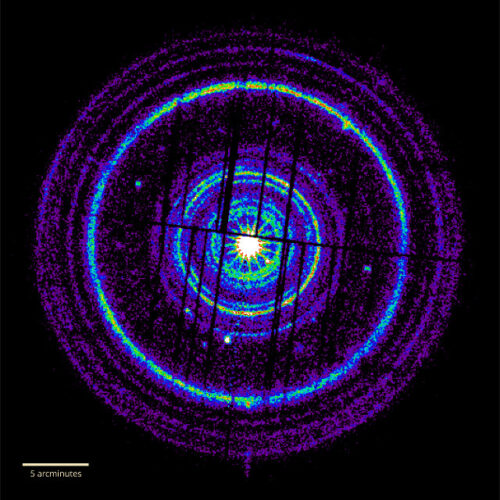
The concentric rings generated by the GRB221009A gamma-ray burst as seen by the XMM-Newton space telescope (Image ESA/XMM-Newton/M. Rigoselli (INAF))

A special issue of “The Astrophysical Journal Letters” is focused on the gamma-ray burst cataloged as GRB221009A, indicated since the first estimates of its characteristics as the gamma-ray burst of the century. Various teams of researchers conducted various types of analyzes of the data collected by many instruments that detected the emissions from GRB221009A and the so-called afterglow, meaning from the residues of its emissions, in several electromagnetic bands. The wealth of data indicates that this is the most powerful gamma-ray burst ever observed and offers new insights into these extremely energetic phenomena. In this case, it was a long gamma-ray burst, probably generated by the collapse of the core of a massive star and the subsequent birth of a black hole.

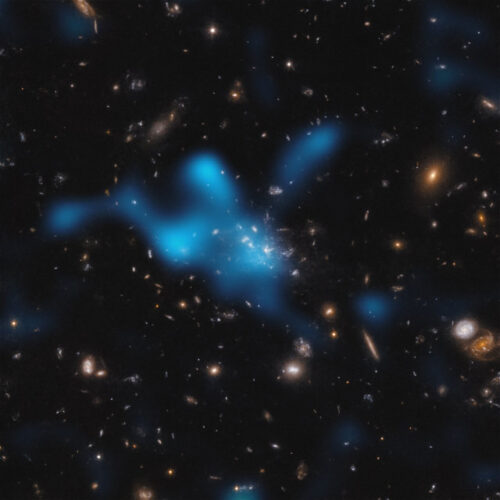
The galaxy protocluster around the Spiderweb Galaxy with gas from the intracluster medium in blue (Image ESO/Di Mascolo et al.; HST: H. Ford)

An article published in the journal “Nature” reports the results of a study on the formation of a primordial galaxy cluster, observed in its early stages. A team of researchers led by Luca Di Mascolo of the University of Trieste, Italy, used the ALMA radio telescope to study the intracluster medium, the gas that permeates the protocluster around the galaxy MRC 1138-262, known as the Spiderweb Galaxy, and has an overall mass greater than the mass of the galaxies that form it. Observations of the intracluster medium in forming clusters are scarce, making those observations precious to understand the formation processes of galaxy clusters.

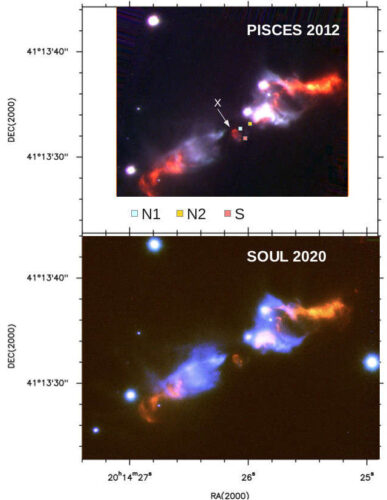
Photographs of the protostar IRAS20126+4104 and its material jets taken in 2012 and 2020 using the FLAO/PISCES and SOUL/LUCI1 instruments

An article published in the journal “Astronomy & Astrophysics” reports a study on the massive protostar cataloged as IRAS20126+4104 which obtained the measurement of the speed of the jets of materials that are ejected at about 100 km/h. A team of researchers led by Fabrizio Massi of the Italian National Institute of Astrophysics in Arcetri used the SOUL instrument installed on the Large Binocular Telescope (LBT) to obtain the details necessary to measure the displacements that occurred with respect to archive images dating back to 2003 and 2012. This result helps to better understand the formation processes of massive stars.

The star WR 124 as seen by the James Webb Space Telescope (Image NASA, ESA, CSA, STScI, Webb ERO Production Team)

An image captured by the James Webb Space Telescope shows the star WR 124 and the surrounding nebula in never-before-seen detail. This is a case where a star is nearing the end of its life, which could culminate in a supernova. For this reason, astronomers have been keeping an eye on WR 124 for years with various instruments and it was among Webb’s first observation targets in June 2022. The very powerful stellar wind typical of so-called Wolf-Rayet stars caused the loss of this star’s outer layers, which formed the nebula that surrounds it. Its details have now been captured in the breathtaking image thanks to Webb’s NIRCam and MIRI instruments to better understand the processes taking place before the possible supernova or another type of death.