Telescopes

The new scheme of the orbits of the planets of the TOI 700 system

An article accepted for publication in “The Astrophysical Journal Letters” reports the discovery of the exoplanet TOI 700 e. A team of researchers used observations conducted with NASA’s TESS space telescope and confirmed with other instruments to find it. It’s the fourth planet discovered in the TOI 700 red dwarf system and is interesting because it’s a rocky planet a bit smaller than Earth. Its habitability potential is yet to be assessed because it’s within the so-called optimistic habitable zone, where a planet can only have liquid water on its surface for part of its history.

The six barred spiral galaxies identified by the James Webb Space Telescope

An article accepted for publication in “The Astrophysical Journal Letters” reports the discovery of six barred spiral galaxies that are between 8.4 and 11 billion years old. A team of researchers used the James Webb Space Telescope within the CEERS survey to observe enough details of these galaxies to identify the two extensions of stars that start from their center and reach the outer disk in a structure that resembles a bar. It’s a crucial structure for the evolution of these galaxies, as it favors the growth of the supermassive black holes at their center and star formation in their central regions.

The galaxy clusters MOO J1014+0038 (left panel) and SPT-CL J2106-5844 (right panel) as seen by the Hubble Space Telescope's Wide Field Camera 3 instrument at infrareds

An article published in the journal “Nature” reports the results of a study on the so-called intracluster light that permeates galaxy clusters. Hyungjin Joo and M. James JeeĀ of Yonsei University in Seoul, South Korea, used the Hubble Space Telescope to examine ten galaxy clusters and the glow within them. The surprising and therefore interesting discovery was that intracluster light is abundant even in the oldest clusters, a sign that the stars that emit it were ejected from their galaxies a long time ago. This suggests that this happened at the same time as the formation and growth of the clusters.

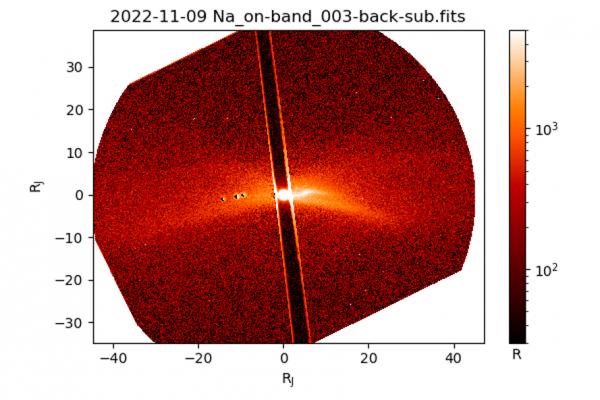
An image captured by the IoIO instrument on November 9, 2022, showing the sodium nebula emissions from the outburst originating from Io

A violent volcanic outburst was detected on Jupiter’s moon Io by Jeff Morgenthaler using the Io Input/Output observatory (IoIO) at the Planetary Science Institute (PSI). The scientist of this non-profit organization based in Arizona has been monitoring Io since 2017, observing several outbursts but the one in autumn 2022 was the most violent. This monitoring can also be useful for the mission of NASA’s Juno space probe, in orbit around Jupiter, as NASA is planning a Io flyby in December 2023 in which its instruments will be able to carry out measurements of the emitted gases such as sodium and ionized sulfur.

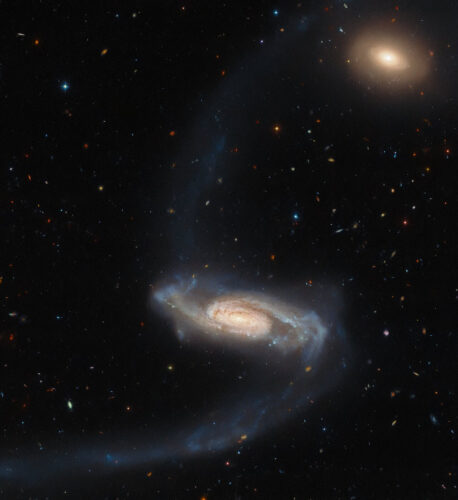
The galaxy ESO 415-19 (Image ESA/Hubble & NASA, J. Dalcanton, Dark Energy Survey/DOE/FNAL/DECam/CTIO/NOIRLab/NSF/AURA)

An image captured by the Hubble Space Telescope shows the galaxy ESO 415-19 and its long arms, making it a decidedly unusual spiral galaxy. It’s a spiral galaxy but was included in the Atlas of Peculiar Galaxies due to the extraordinary extension of its arms. So far, no other traces of the cosmic interaction that caused this anomaly in ESO 415-19 have been found but its peculiarity made it an interesting object of observation with Hubble and other instruments. For publication, photos taken with Hubble’s ACS instrument were combined with others captured with the DECam camera on the Victor M. Blanco telescope.