Telescopes

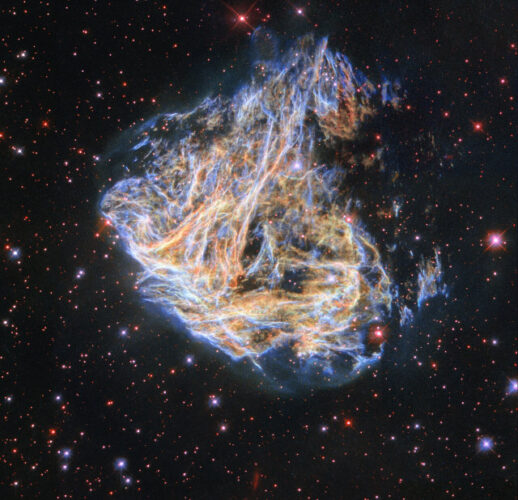
The supernova remnants DEM L 190 (Image ESA/Hubble & NASA, S. Kulkarni, Y. Chu)

An image captured by the Hubble Space Telescope portrays the supernova remnants cataloged as DEM L 190 or LMC N49 or by other designations observed in the Large Magellanic Cloud. The debris produced by the explosion of a massive star formed what appear from Earth as delicate colored filaments. Those materials projected into interstellar space could end up in other stellar systems, perhaps even in protoplanetary disks which will be enriched by the elements generated by the progenitor star and by the supernova.

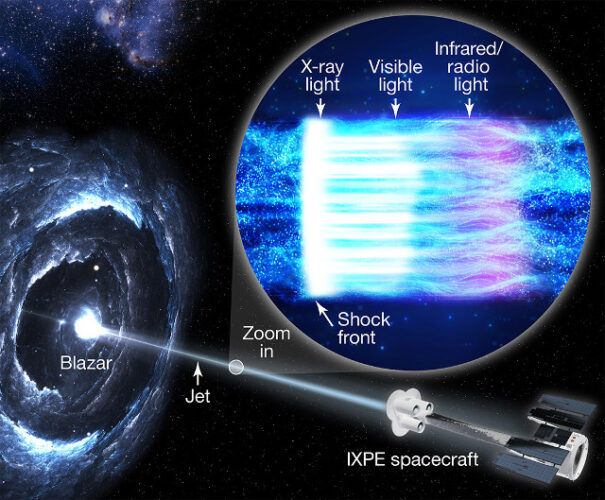
Diagram of the Markarian 501 blazar and its jet as observed with the IXPE Space Telescope

An article published in the journal “Nature” reports a study on the blazar Markarian 501, or simply MRK 501, which offers an explanation for the jets of particles emitted at speeds close to the speed of light. A team of researchers used NASA’s IXPE space telescope to study Markarian 501 and concluded that shock waves within the jets were the most likely explanation.

Markarian 501 is a blazar, a type of active galactic nucleus that emits powerful jets of particles at speeds approaching the speed of light. When one of its jets is aimed at Earth, this type of object is called a blazar. These objects are powered by supermassive black holes surrounded by disks of materials.

Artist's concept of the exoplanet WASP-39b and its star (Image NASA, ESA, CSA, J. Olmsted (STScI))

Five articles, three of which were accepted for publication in the journal “Nature” and two still under peer review, report various aspects of a study on the exoplanet WASP-39b. Many researchers participated in various ways in examining observations conducted with the James Webb Space Telescope focused in particular on the atmosphere of this very hot planet. Webb’s various instruments made it possible to detect a number of substances in WASP-39b’s atmosphere such as carbon monoxide, sodium, and potassium. For the first time, sulfur dioxide was detected in the atmosphere of an exoplanet and indicate that photochemical reactions are taking place.

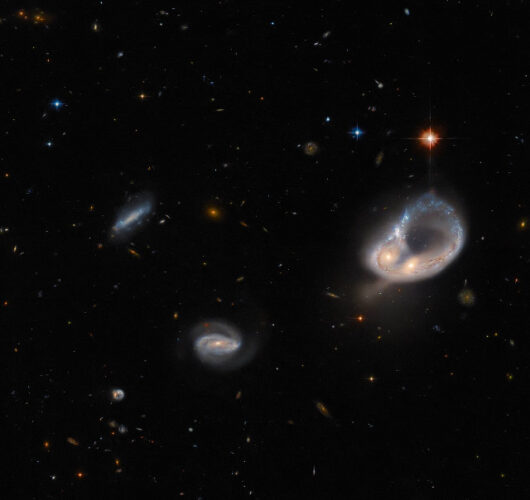
Arp-Madore 417-391, or simply AM 417-391, with other galaxies and stars

An image captured by the Hubble Space Telescope’s ACS instrument shows Arp-Madore 417-391, or simply AM 417-391, a pair of merging galaxies. It’s part of the Arp-Madore catalog, which collects particularly peculiar galaxies in the southern sky. It includes pairs of galaxies interacting at levels that go up to a merger just like AM 417-391.

The Advanced Camera for Surveys (ACS) instrument is optimized for hunting galaxies and galaxy clusters in the ancient universe. The AM 417-391 pair is “only” 670 million light-years away and makes an excellent object of study for astronomers interested in galaxy mergers.

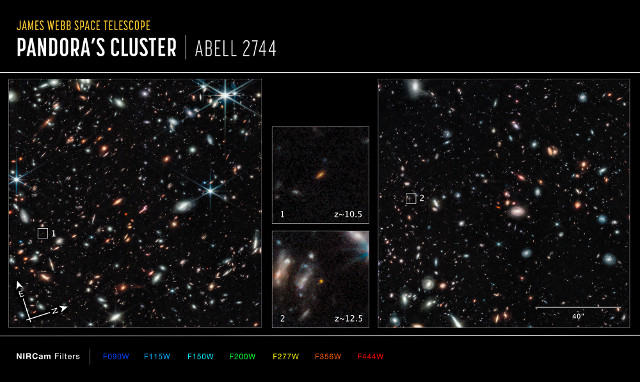
The galaxy cluster Abell 2744, nicknamed Pandora Cluster, with two boxes in the center showing the galaxies GLASS-z10 (1) and GLASS-z12 (2)

Two articles published in “The Astrophysical Journal Letters” report the results of the analysis of observations of the Abell 2744 galaxy cluster and the surrounding area with the James Webb Space Telescope. Two teams of researchers led respectively by Marco Castellano of the National Institute for Astrophysics in Rome, Italy, and by Rohan Naidu of the Harvard-Smithsonian Center for Astrophysics of MIT examined in particular two very distant galaxies. The galaxy called GLASS-z12 by the second team could be the oldest identified so far because according to estimates, it dates back to 350 million years after the Big Bang. The other galaxy, called GLASS-z10, is estimated to date back to 450 million years after the Big Bang.