
Telescopes

The Cartwheel galaxy seen by the James Webb Space Telescope (Image NASA, ESA, CSA, STScI)

An image captured by the James Webb Space Telescope shows the Cartwheel galaxy in greater detail than those obtained in the past with other telescopes. A combination of Webb’s NIRCam and MIR instruments allowed the identification of individual stars and star-forming regions while also offering new insights into the behavior of the supermassive black hole within this peculiar galaxy. This is a new help in the study of the changes taking place in what is most likely the consequence of a collision between two different galaxies with a transformation still taking place.

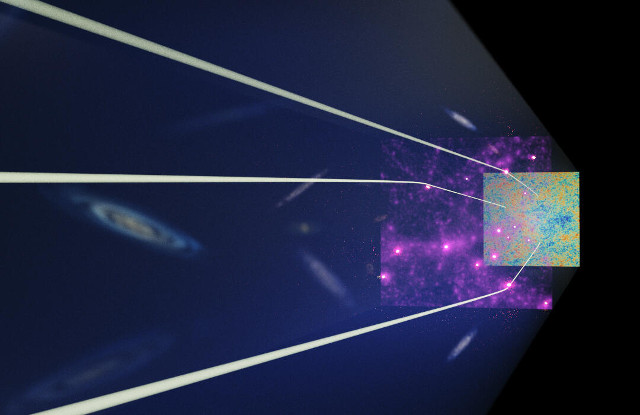
An artistic representation of the combination of the observations obtained in the HSC-SSP survey and the cosmic microwave background data collected by the Planck Surveyor space probe

An article published in the journal “Physical Review Letters” reports the results of an analysis of dark matter distribution around 1.5 million primordial galaxies. A team of researchers led by Hironao Miyatake of the Japanese University of Nagoya used observations conducted with the Subaru telescope and analyzed data collected by the Planck Surveyor space probe to detect distortion of the cosmic microwave background (CMB).

The results of this study show fluctuations in dark matter distribution in the early universe that led to inhomogeneity in the aggregation of ordinary matter that formed galaxies. That aggregation is lower than predicted by the Lambda-CDM model, the one that currently best describes the observations. The uncertainty lies in the difficulty of obtaining precise results in examining very distant galaxies.

The runaway star Zeta Ophiuchi and its bow shock

An article accepted for publication in the journal “Astronomy and Astrophysics” reports a study on the star Zeta Ophiuchi, a so-called runaway star that became famous even beyond the field of astronomy for its bow shock, the enormous shock wave similar to the waves generated in the water by the bow of a ship. A team of researchers led by Samuel Green from the Institute for Advanced Studies in Dublin, Ireland, built detailed computer models of the bow shock to try to explain the observed data. The results confirm the origins of Zeta Ophiuchi but only partially explain the X-ray emissions detected.

Artistic concept of gravitationally bound binary systems (Image NASA/JPL-Caltech/UCLA)

An article published in the journal “Monthly Notices of the Royal Astronomical Society Letters” offers a number of clues about the triple system TIC 470710327 being the result of a stellar merger. A team of researchers used the HERMES spectrograph mounted on the Mercator Telescope for follow-up observations of this system, which was discovered thanks to NASA’s TESS space telescope, a discovery that was announced in an article published in April 2022 in the journal “Monthly Notices of the Royal Astronomical Society”. Computer simulations led the researchers to conclude that originally there were two gravitationally-bound binary systems and in one of them, the two stars merged into one that ended up forming a triple system with the other two.

Artist's representation of the VFTS 243 system

An article published in the journal “Nature Astronomy” reports the discovery of a probable dormant black hole in the Large Magellanic Cloud, one of the dwarf galaxies satellite of the Milky Way. A team of researchers spotted it in the VFTS 243 system after a thorough examination of a binary system located in the Tarantula Nebula in which a candidate was identified to be tested in the search for black holes. Six years of observations conducted with ESO’s VLT allowed to rule out other possible explanations for the nature of the objects studied. An interesting conclusion is that the black hole discovered is the result of a collapse of the parent star that occurred without a supernova.