Launch vehicles

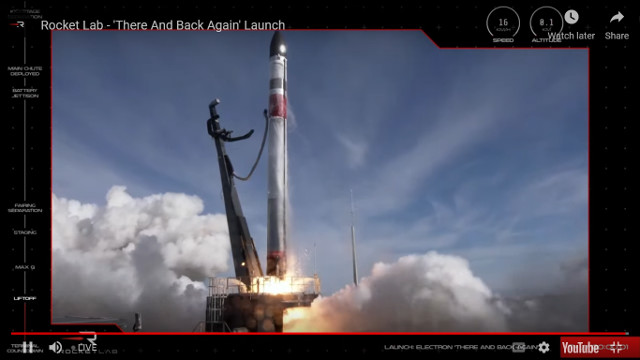
The Electron rocket starts "There And Back Again" mission (Image courtesy Rocket Lab)

A few hours ago, Rocket Lab’s first attempt to use a Sikorsky S-92 helicopter to catch the first stage of its Electron rocket while it was returning to the ground during a mission called “There And Back Again” was successful. The goal is a controlled transport of the first stage to the ground in order to reuse it. After catching it, the pilot found that the load had different characteristics from those experienced during the tests and let go of the first stage, which splashed down and was recovered by Rocket Lab’s ship.

The New Shepard rocket blasting off in its NS-18 flight (Image courtesy Blue Origin)

Yesterday, Blue Origin conducted the second crewed flight of its New Shepard rocket, which included actor William Shatner, famous especially for playing James Kirk in the “Star Trek” saga. The rocket blasted off from the company’s spaceport in Van Horn, Texas, and after about 3 minutes the spacecraft named “RSS First Step” separated from the rocket and reached an altitude of about 107 kilometers, more than the 100 kilometers of the Kármán Line that officially marks the boundary with space. Both the single-stage rocket and the spacecraft are reusable, so both landed at the end of the flight.

The New Shepard rocket blasting off (Image courtesy Blue Origin)

A little while ago, Blue Origin conducted the first crewed flight, which included owner Jeff Bezos, of its New Shepard rocket. It blasted off from the company’s spaceport in Van Horn, Texas, and after about 3 minutes the spacecraft named “RSS First Step” separated from the rocket and reached an altitude of a little more than 106 kilometers, more than the 100 kilometers of the Kármán Line that officially marks the boundary with space. Both the single-stage rocket and the spacecraft are reusable, so both landed at the end of the flight.

60 Starlink satellites blasting off atop a Falcon 9 rocket (Image courtesy SpaceX)

A little while ago 60 satellites of the Starlink constellation were launched on a Falcon 9 rocket from Cape Canaveral. After about an hour they were successfully deployed into their orbit at an altitude of about 280 kilometers all together and then started slowly disperse. This is SpaceX’s second mission to put the Starlink constellation into orbit to provide a global Internet connection coverage.