Satellites

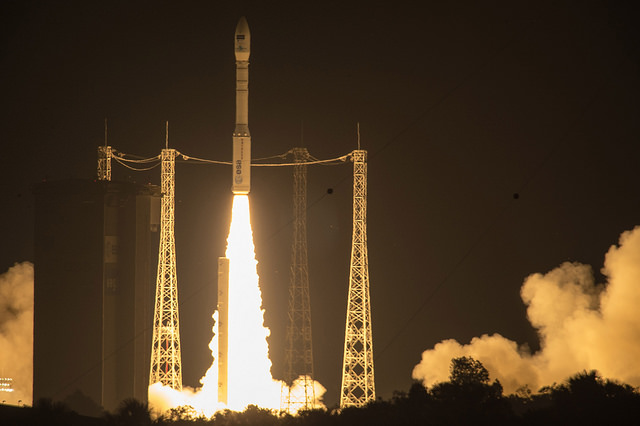
A Long March 3B rocket blasting off, officially carrying the TXJSSY-1 satellite (Photo courtesy Xinhua agency. All rights reserved)

Saturday, September 12, China launched a satellite announcing it only later. It’s not the first time that something like that happened because the Chinese provide information on their space missions when their government decides it and typically in limited amount. Officially, the launch involved a test communications satellite called TXJSSY-1 of a new type called Communications Engineering Test Satellite. However, various rumors spread out about the real nature of the launch, partly because of growing tensions in the South China Sea.

The Magellanic Clouds and an interstellar filament seen by the Planck Surveyor satellite (Image ESA and the Planck Collaboration)

ESA has released an image created using data from the Planck Surveyor satellite offering a very special portrait of an interstellar filament and the Magellanic Clouds. Those are two dwarf galaxies that are part of the Milky Way’s neighborhood and Planck detected the dust between the stars within them during its mission. The main purpose of this satellite was to study the cosmic microwave background radiation (CMB or CMBR), but the data collected are also useful to map the galaxies’ dust and magnetic fields.

Artistic concept of NASA's SMAP satellite wit its huge rotating mesh reflector (Image NASA)

NASA announced the impossibility to reactivate the radar of its SMAP (Soil Moisture Active Passive) satellite. The instrument ceased to function on July 7 and NASA engineers had been trying to reactivate it for weeks but without success. SMAP is an observatory designed to monitor the moisture present in the top 5 centimeters (2 inches) of soil and now will continue its mission in a limited way.

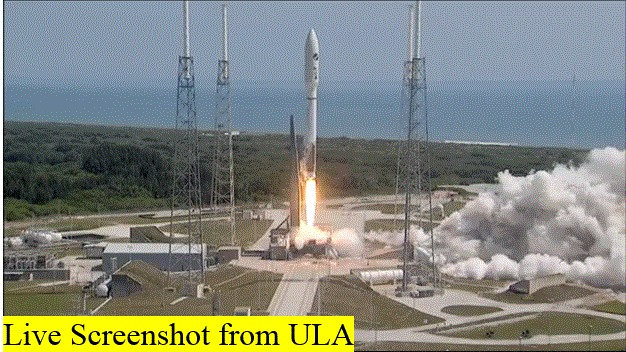
The X-37B shuttle blasting off atop an Atlas V 501 rocket starting its OTV-4 mission (Screenshot from ULA webcast)

The mini-shuttle X-37B blasted off atop an Atlas V 501 rocket from Cape Canaveral. The launch seems to have gone well but ULA (United Launch Alliance), which manages it, broadcat the images providing information on the progress of the operations just for a few minutes. That’s because the mission of this spaceplane is carried out by the US Air Force and is partially covered by military secret.