
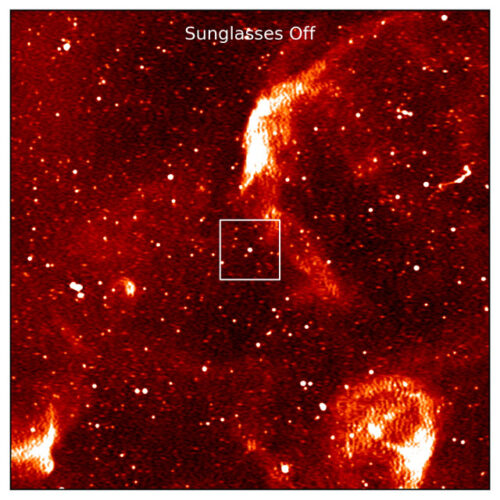
The pulsar PSR J0523-7125 in the square seen by MeerKAT (Image courtesy Yuanming Wang)

An article published in “The Astrophysical Journal” reports the discovery of a pulsar cataloged as PSR J0523-7125, the brightest pulsar discovered outside the Milky Way. A team of researchers led by Tara Murphy of the Australian University of Sydney used a new technique based on the analysis of the polarization of the light emitted by the pulsar to identify it among the observations conducted with the ASKAP radio telescope. The polarization was crucial in the identification because it made it possible to understand that the light came from a pulsar and not from an object of another type.

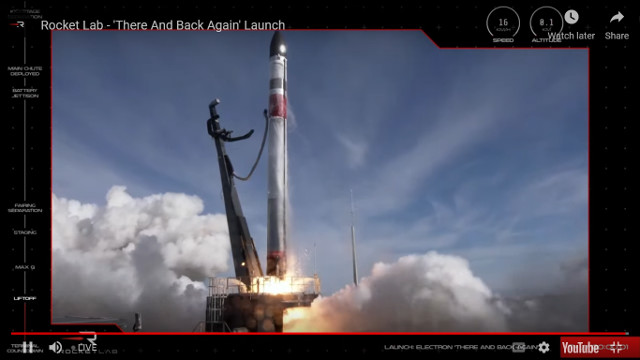
The Electron rocket starts "There And Back Again" mission (Image courtesy Rocket Lab)

A few hours ago, Rocket Lab’s first attempt to use a Sikorsky S-92 helicopter to catch the first stage of its Electron rocket while it was returning to the ground during a mission called “There And Back Again” was successful. The goal is a controlled transport of the first stage to the ground in order to reuse it. After catching it, the pilot found that the load had different characteristics from those experienced during the tests and let go of the first stage, which splashed down and was recovered by Rocket Lab’s ship.

A section of the LHC tunnel (Photo courtesy CERN)

The LHC (Large Hadron Collider), the largest particle accelerator in the world, has resumed work in preparation for the new work program, code-named Run 3, which is scheduled to start in July. The initial operations are the ones necessary to test the equipment after more than three years of update work. On April 22, the first proton beams were injected in opposite directions into the 27-kilometer the LHC ring. If all goes as planned, Run 3 will begin in July pending the completion of other works that will lead to the enhanced version called High Luminosity the LHC (HiLumi LHC or simply HL-LHC).

The Crew Dragon Freedom spacecraft docking with the International Space Station (Image NASA TV)

A few hours ago, SpaceX’s Crew Dragon Freedom spacecraft docked to the International Space Station’s Harmony module completing the first part of its Crew-4 or SpaceX Crew-4 mission that began almost 16 hours earlier with its launch. After checking that the pressure is correctly balanced, the hatch will be opened to allow Robert Hines, Samantha Cristoforetti, Jessica Watkins, and Kjell Lindgren to enter the Station.

SpaceX's Crew Dragon Freedom spacecraft starting its Crew-4 mission blasting off atop a Falcon 9 rocket (Image NASA TV)

A little while ago, SpaceX’s Crew Dragon Freedom spacecraft blasted off atop a Falcon 9 rocket from the Kennedy Space Center in its Crew-4 or SpaceX Crew-4 mission with Robert Hines, Samantha Cristoforetti, Jessica Watkins, and Kjell Lindgren . After about eleven minutes, it successfully separated from the rocket’s last stage and went en route to carry out its mission. This is the 4th crewed mission of the Crew Dragon spacecraft within the normal rotation of the International Space Station crew. This is also the first mission for the Freedom.