The Stimson formation on Mars (Image NASA/Caltech-JPL/MSSS)

An article published in the journal “Proceedings of the National Academy of Sciences” reports the detection of samples rich in carbon-12, which on Earth is associated with biological processes, in Gale crater on Mars by NASA’s Mars Rover Curiosity. A team of researchers used the TLS instrument, part of Curiosity’s SAM mini-laboratory, to analyze the samples to check the amount of isotopes as well. The result is a limited presence in some samples of carbon-13 compared to that detectable in the atmosphere and in Martian meteorites. On Earth, such a result indicates that the sample was produced by some biological process. However, the researchers also offered alternative explanations related to non-biological processes.

A composite image of the central area of ​​the Shapley Concentration within the Shapley supercluster

An article accepted for publication in the journal “Astronomy & Astrophysics” reports the observations of an interaction within the Shapley supercluster, one of the largest known structures in the universe, with collisions between galaxies within it. A team of researchers used in particular observations conducted with three radio telescopes: the Australian ASKAP, the South African MeerKat, and the Indian GMRT. That data was complemented with optical frequency observations conducted with the VST in Chile and X-ray observations with NASA’s XMM-Newton space telescope. Galaxy merger processes are occurring among relatively small groups but offer information on consequences at various scales, with influences even on large structures of galaxy clusters.

Artist's concept of the exoplanet Wasp-103b and its star (Image ESA)

An article published in the journal “Astronomy & Astrophysics” reports a study of the exoplanet Wasp-103b that offers evidence of its oval shape. A team of researchers used data collected by ESA’s CHEOPS space telescope to have the accuracy needed to assess this gas giant’s anomalous shape. It’s due to its star’s powerful tidal forces, as the star is a bit larger and more massive than the Sun, on this planet due to their proximity. In fact, Wasp-103b is so close to its star that its year lasts a little less than an Earth day.

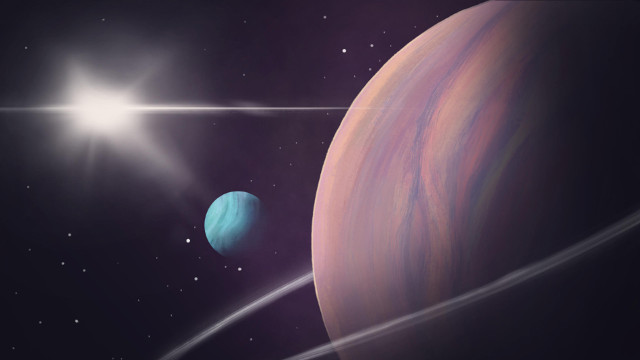
Artist's concept of the exoplanet Kepler-1708 b with its moon (Image courtesy Helena Valenzuela Widerström)

An article published in the journal “Nature Astronomy” reports the discovery of an exomoon candidate that was cataloged as Kepler-1708 b-i. A team of researchers led by David Kipping of Columbia University analyzed data collected by NASA’s Kepler Space Telescope with the specific purpose of looking for possible moons around exoplanets discovered thanks to Kepler. The Jupiter-sized gas giant Kepler-1708 b has a signal indicating the possible presence of a moon that would be a little smaller than the planet Neptune.

Jupiter's North Pole with eight cyclones surrounding a central cyclone

An article published in the journal “Nature Physics” describes similarities between the cyclones present at the planet Jupiter’s poles and the vortices existing in the Earth’s oceans. A team of researchers used images captured by NASA’s Juno space probe of Jupiter cyclones to study them, compare them with similar ocean phenomena, and describe them by applying geophysical fluid dynamics. The conclusion is that Jupiter cyclones are also produced and continue their existence thanks to convection phenomena that lead masses of hot gas to rise and then cool down and descend again into the deeper layers of the Jovian atmosphere.