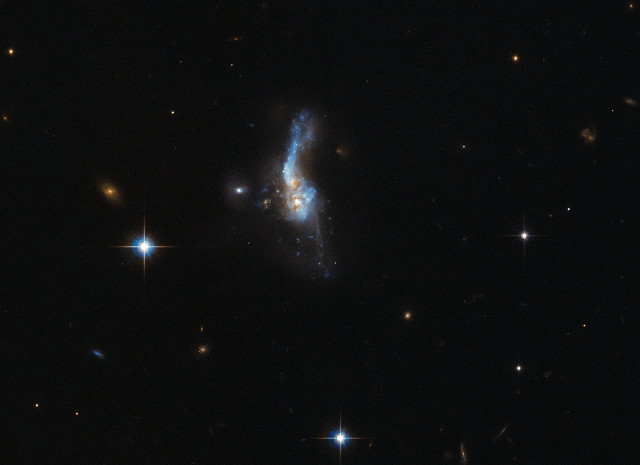
A hyperluminous galaxy seen by Hubble (Image ESA/Hubble)

An article published in the journal “Astronomy & Astrophysics” reports a study on hyperluminous galaxies. A team of researchers led by Lingyu Wang of the Netherlands Institute for Space Research, Utrecht, used the LOFAR radio telescope to assess the amount of hyperluminous galaxies in infrared and concluded that it’s ten times higher than what stars can produce according to current models. If the models are correct, it means that in many galaxies there are other light sources such as an active galactic nucleus powered by a supermassive black hole surrounded by large amounts of materials heated to the point of generating electromagnetic emissions.

SpaceX's Crew Dragon Resilience spacecraft docking to the International Space Station (Image NASA TV)

A few hours ago, SpaceX’s Crew Dragon Resilience spacecraft docked to the International Space Station’s Harmony module completing the first part of its Crew-1 or SpaceX Crew-1 mission that began last Sunday with its launch. After checking that the pressure is correctly balanced, the hatch was opened to allow Shannon Walker, Victor Glover, Mike Hopkins, and Soichi Noguchi to enter the Station.

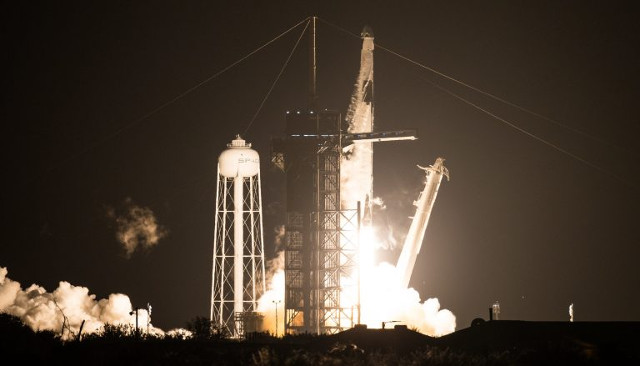
The Crew Dragon Resilience starts its Crew-1 mission blasting off atop a Falcon 9 rocket (Photo NASA/Joel Kowsky)

A few hours ago, SpaceX’s Crew Dragon Resilience spacecraft blasted off atop a Falcon 9 rocket from Cape Canaveral in its Crew-1 o SpaceX Crew-1 mission with Shannon Walker, Victor Glover, Mike Hopkins, and Soichi Noguchi on board. After about eleven minutes, it successfully separated from the rocket’s last stage and went en route to carry out its mission. This is the second crewed mission of the Crew Dragon spacecraft, this time within the normal rotation of the International Space Station crew.

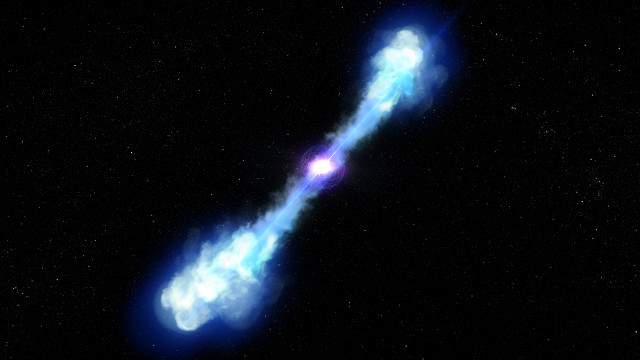
An artistic illustration of a short gamma-ray burst such as GRB 200522A

An article published in “The Astrophysical Journal” reports a study on the kilonova observed on May 22, 2020, and its consequences. It was the merger between two neutron stars that generated a short gamma-ray burst cataloged as GRB 200522A and as a result, produced what from the first analyzes appears to be a magnetar, still a neutron star but of the type characterized by an extremely powerful magnetic field. A team of researchers led by astronomer Wen-fai Fong of Northwestern University in Evanston, Illinois, USA, considered various possible explanations for the observed event, which had an exceptional brightness, and a kilonova that produced a magnetar was the most likely explanation.

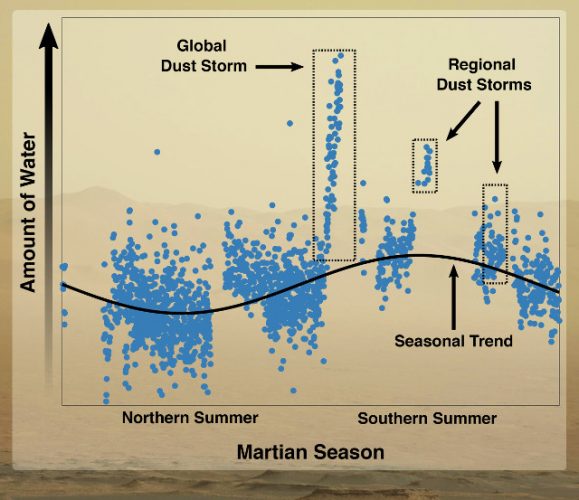
A depiction of water in Mars' atmosphere with peaks during periods of both regional and global dust storms

An article published in the journal “Science” reports a study that explains where most of the water that the planet Mars possessed when it was young, when it was in the liquid state on its surface, has gone. A team of researchers led by Shane Stone of the University of Arizona, USA, used data collected by NASA’s MAVEN space probe to track the movements of water in the atmosphere, up to high altitudes, where there are reactions that break it down and produce atomic hydrogen that is dispersed in space. This study highlighted the role of dust storms in water loss.