
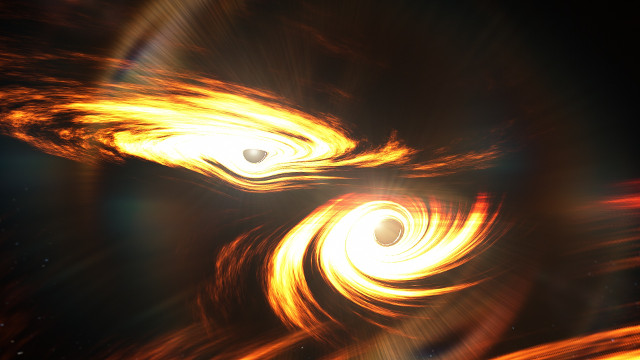
Artistic concept of two black holes that are about to merge (Image courtesy Mark Myers, ARC Centre of Excellence for Gravitational Wave Discovery (OzGrav))

Two articles, one published in the journal “Physical Review Letters” and one in “The Astrophysical Journal Letters”, report various aspects of an analysis of the data collected by the LIGO and Virgo Collaborations on the merger between two black holes of which the gravitational waves have been detected in the event cataloged as GW190521. The two black holes involved had masses out of the ordinary, estimated at 66 and 85 times the Sun’s, for a total mass of about 150-151 times the Sun’s. The black hole produced has a mass estimated at 142 times the Sun’s, which means that about 9 solar masses were turned into energy during that event to form an intermediate-mass black hole, the first observed at its birth.

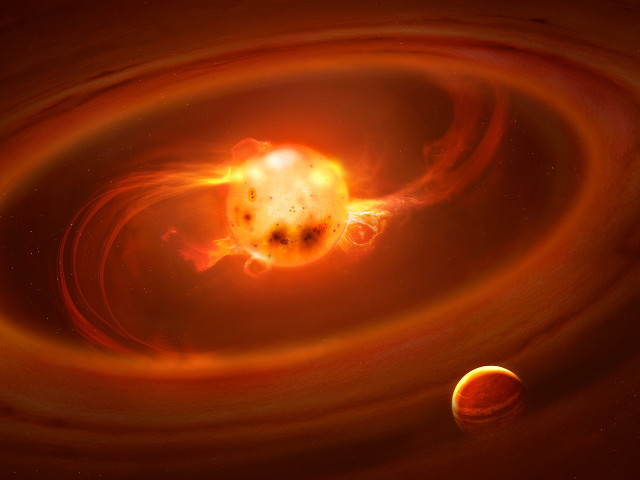
Artist's concept of a protostar attracting gas (Image courtesy A. Mark Garlick )

An article published in the journal “Nature” reports the results of observations of the very young TW Hydrae system in which for the first time the columns of materials that contribute to the formation of new stars have been directly observed. A team of researchers part of the GRAVITY collaboration that runs the instrument with that name mounted on ESO’s VLTI in Chile used it to obtain the best details ever studying TW Hydrae. This star has yet to complete its formation, so these observations provide new details on those processes.

The galaxy TXS 0128+554 seen by VLBA at various frequencies (Image Lister, et al.; Sophia Dagnello, NRAO/AUI/NSF)

An article published in “The Astrophysical Journal” reports a study of the galaxy TXS 0128+554 and in particular of the jets of particles emitted by the supermassive black hole at its center that form two lobes that appear to have different ages. A team of researchers led by Matthew Lister of Purdue University used the Very Long Baseline Array (VLBA) and NASA’s Chandra X-ray Observatory to observe the jets of materials and gamma-ray emissions. The conclusion is that the jets started about 80 years ago, stopped and then started again about 10 years ago.

The dual quasar SDSS J141637.44+003352.2

An article published in “The Astrophysical Journal” reports the confirmation of three pairs of supermassive black holes in close proximity to the point that we will see them merge in a future that is near from an astronomical point of view. A team of researchers led by Dr. John Silverman of the Kavli Institute for the Physics and Mathematics of the Universe used three observatories on Mount Maunakea in Hawaii: the Subaru Telescope, the Keck Observatory, and the Gemini Observatory to examine a huge amount of quasars in search of traces of a dual center, and among 421 candidates they confirmed three. These are rare cases, to the point that the estimate is that 0.3% of quasars are dual with two supermassive black holes on a collision course.

The area where hydroxylamine was detected

An article published in “The Astrophysical Journal Letters” reports the discovery of hydroxylamine, a precursor of RNA nucleotides, in the molecular cloud G+0.693-0.027, in the heart of the Milky Way. A team led by VĂ­ctor M. Rivilla, of the Centro de AstrobiologĂ­a in Madrid and associated with the Italian National Institute of Astrophysics in Arcetri used the IRAM radio telescope to detect the chemical signature of hydroxylamine. Other molecules important in the formation of RNA and DNA were already detected in space, this is more evidence that at least part of life building blocks can somehow seed a newly formed planet bearing fruit where conditions are suitable.