Artist's concept of black dwarf star (Image Baperookamo)

An article published in the journal “Monthly Notices of the Royal Astronomical Society” reports a research on the possibility that in a very distant future, estimated in 10^1100 years, even black dwarfs might explode in supernovae. Matt Caplan of the University of Illinois studied the models of white dwarf evolution as they will keep on cooling while pycnonuclear reactions, which occur at low temperatures but very high density, will generate iron-56. In quite a long time, even elementary particles will start decaying, and this will cause the explosion of the most massive black dwarfs, with masses between 1.2 and 1.4 times the Sun’s. It could be the last significant natural event in the universe.

Betelgeuse seen by Hubble (Image Andrea Dupree (Harvard-Smithsonian CfA), Ronald Gilliland (STScI), NASA and ESA)

An article published in “The Astrophysical Journal” reports a study on the star Betelgeuse’s dimming that occurred between the end of 2019 and the first quarter of 2020 that had suggested that its supernova explosion was imminent. A team of researchers led by Andrea Dupree of the Center for Astrophysics at Harvard and Smithsonian used the Hubble Space Telescope with ultraviolet observations to find traces of a gigantic mass of hot plasma that rose from Betelgeuse’s surface. That plasma moved away, cooling and turning into dust that covered the star’s surface, reducing its brightness to a third of normal.

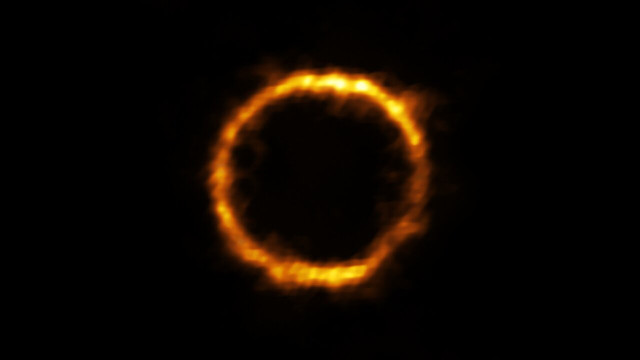
The galaxy SPT0418-47 (Image ALMA (ESO/NAOJ/NRAO), Rizzo et al.)

An article published in the journal “Nature” reports the study of a primordial galaxy we see as it was when the universe was 1.4 billion years old and resembles the Milky Way, a surprise because we see it when it was very young, and according to current theories should be turbulent and unstable. A team of researchers led by Francesca Rizzo, a Ph.D. student at the Max Planck Institute for Astrophysics in Germany, used the ALMA radio telescope to observe this galaxy, cataloged as SPT-S J041839-4751.9, or simply SPT0418-47. Help came from a gravitational lens that magnified the image, allowing to see the similarities with the Milky Way and gather new information on the early stages of galaxy evolution.

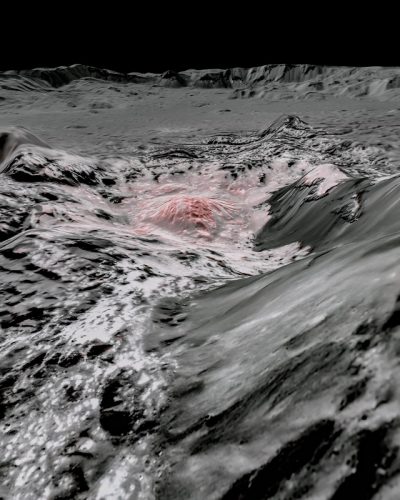
Cerealia Facula in Occator Crater

The Nature group has dedicated a special issue to the dwarf planet Ceres with a series of articles published in its journals. Various teams of researchers studied different aspects of the geology of Ceres with particular attention to the presence of water and hydrated sodium chloride, in very simple words table salt mixed with water. There are confirmations of the presence in the past of an underground ocean of which a strong presence of salts significantly lowered the freezing point. The salts present in the famous bright spots such as that in Occator Crater are among the remains of that ocean: they’re mainly sodium carbonate and ammonium chloride, but there’s also sodium chloride.

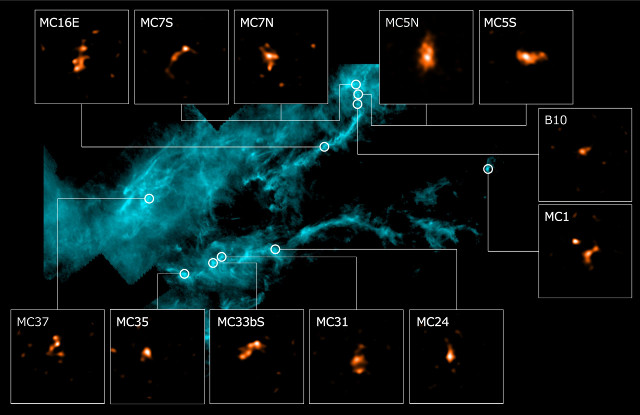
The stellar eggs seen by ALMA

Two articles, one published in “The Astrophysical Journal” and one in “The Astrophysical Journal Letters”, report a census of what were called stellar embryos in the Taurus Molecular Cloud. A team of researchers used the ALMA radio telescope to observe 32 prestellar objects and 7 protostars that offer new insights into the processes leading to the birth of stars. One of the articles focuses on the discovery of a bipolar outflow formed by a pair of gas streams that could be clues to the birth of a star.