
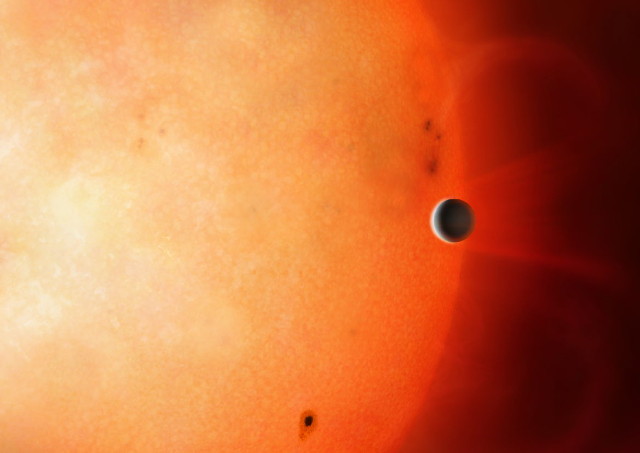
Artist’s impression showing a Neptune-sized planet in the Neptunian Desert (Image courtesy University of Warwick/Mark Garlick)

An article published in the journal “Nature” reports a study on the exoplanet TOI-849b, which appears to be the core of a gas giant stripped of its atmosphere. A team of researchers led by Dr. David Armstrong of the British University of Warwick used data collected by NASA’s TESS space telescope and ESO’s HARPS spectrograph to estimate the characteristics of TOI-849b. The result was that its mass is approximately 40 times the Earth’s with a size similar to Neptune’s, which means that its density is similar to the Earth’s. Its proximity to its star is probably the reason why it doesn’t have an atmosphere, although the possibility remains that it’s a sort of failed gas giant that couldn’t capture gas after the formation of the observed core.

Artist's concept of Kelt-9b and its star in the background (Image NASA's Goddard Space Flight Center/Chris Smith (USRA))

An article published in “The Astronomical Journal” reports a study on the characteristics of the orbit of the exoplanet KELT-9b, an ultra-hot Jupiter very close to its star. A team of researchers led by John Ahlers of the Exoplanets and Stellar Astrophysics Laboratory at NASA’s Goddard Space Flight Center used data collected by NASA’s TESS space telescope to create a model of the interaction between star and exoplanet that allowed to understand better the peculiar characteristics of the star and the extreme ones of KELT-9b. For example, it turned out that the star spins so fast that its poles are flattened making them hotter, and the exoplanet orbits around those poles with the consequence that it has two summers when it passes over them while it has two winters when it passes over the star’s equator.

Artist's concept of a luminous blue variable star (ESO/L. Calçada)

An article published in the “Monthly Notices of the Royal Astronomical Society” reports the mysterious disappearance of a massive star of the luminous blue variable type in the Kinman dwarf galaxy. A team of researchers led by Andrew Allan of Trinity College in Dublin, Ireland, detected the disappearance of that star using ESO’s Very Large Telescope (VLT) in Chile. Additional observations and research of archival data to try to better understand the events led to believe that the most likely possibilities are a transformation that led to a sharp drop in brightness, maybe dimmed even more due to the dust that covered it, and its direct collapse into a black hole without a supernova explosion.

The symbiotic nova V407 Cygni seen by EVN

An article published in the journal “Astronomy & Astrophysics” reports a study of V407 Cygni, the first known gamma-ray nova, discovered in 2010. A team of researchers led by Marcello Giroletti from the Italian National Institute of Astrophysics used data collected using the European VLBI Network (EVN) over 16 different periods to monitor the radio emissions of what is a symbiotic nova. The result was the discovery of shock waves generated by the explosion of materials accumulated on the white dwarf’s surface that forms a couple with a red giant from which it steals them.

Artist's concept of Pōniuāʻena (Image courtesy International Gemini Observatory/NOIRLab/NSF/AURA/P. Marenfeld)

An article accepted for publication in “The Astrophysical Journal Letters” reports the discovery of a very bright primordial quasar that was cataloged as J100758.264+211529.207, or simply J1007+2115, and named Pōniuāʻena. A team of researchers used three Mount Maunakea Observatories in Hawaii to identify one of the oldest known quasars, surpassed in age only by the one cataloged as J1342+0928, whose discovery was announced in December 2017.

From Earth we see Pōniuāʻena as it was about 13 billion years ago, a quasar powered by a supermassive black hole with an estimated mass of 1.5 billion times that of the Sun, almost twice the one that powers J1342+0928. This raises more than ever the problem of the quick growth of some primordial supermassive black holes.