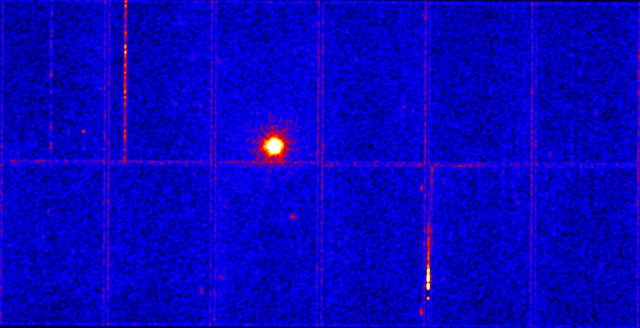
Swift J1818.0-1607 observed by XMM-Newton (Image courtesy ESA/XMM-Newton; P. Esposito et al. (2020))

An article published in “The Astrophysical Journal Letters” reports a study on Swift J1818.0-1607, the youngest pulsar discovered so far, which offers evidence that it’s at the same time a magnetar and one of the very few to also have radio emissions. A team of researchers have used ESA’s XMM-Newton, NASA’s Swift and NuSTAR space telescopes to detect X-ray emissions, and the Sardinia Radio Telescope to detect radio emissions in a complex observation campaign necessary to study the combined characteristics of the two types of neutron star.

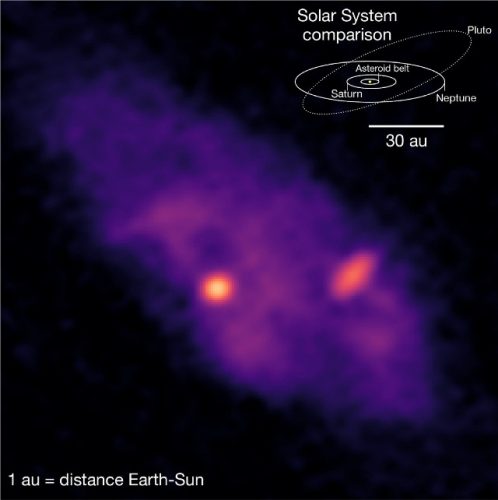
Illustration of GW Orionis's rings

An article published in “The Astrophysical Journal Letters” reports a study of the triple system of GW Orionis, or simply GW Ori, and in particular of the interactions between the three stars that compose it and the disk of gas and dust that surrounds it, divided in three rings. A team of researchers coordinated by the Department of Physics & Astronomy of the University of Victoria, Canada, used the ALMA radio telescope to conduct the observations necessary to identify the three rings, to estimate their masses, and to discover a misalignment between them.

The protostars in IRAS 16293-2422 A

An article accepted for publication in “The Astrophysical Journal” reports observations of a pair of protostars in a system in its formation phase cataloged as IRAS 16293-2422 A. A team of researchers from the astrochemistry group of the Max Planck Institute for Extraterrestrial Physics (MPE) in Munich, Germany, used the ALMA radio telescope to study the two protostars, cataloged as A1 and A2, since it can detect the emissions not filtered by the materials that surround them, also forming the circumstellar disks from to which planets may form in the future. The two protostars are in the initial phase of their formation and are still surrounded by the molecular cloud that constitutes the source of the gas and dust that are forming them.

Proxima Centauri seen from Earth and the New Horizons space probe

NASA has released images obtained by its New Horizons space probe during the interstellar parallax experiment conducted on April 22 / 23, 2020. The LORRI camera was aimed at Proxima Centauri and Wolf 359, two of the stars closest to the system solar, obtaining images that show how they appear in different positions from the ones we see from Earth. It’s an application of the parallax phenomenon with the apparent movement of the two stars caused by the fact that New Horizons is about 7 billion kilometers from Earth. The combination of images captured by New Horizons and an instrument on Earth shows the parallax effect, which in the future could help interstellar navigation instruments like sailors have been using the positions of stars to navigate the seas of Earth.

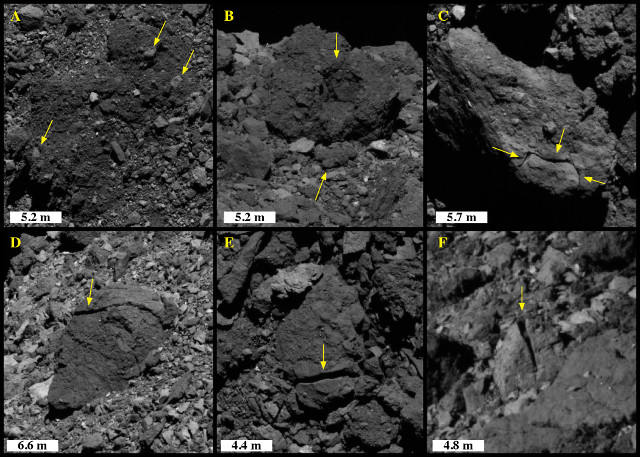
The disaggregation (top row) and linear fractures (bottom row) in rocks on asteroid Bennu

An article published in the journal “Nature Communications” reports the evidence of thermal fractures on asteroid Bennu caused by the temperature difference between day and night. A team of researchers led by Jamie Molaro of the Planetary Science Institute in Tucson, Arizona, examined images of Bennu’s surface captured by NASA’s OSIRIS-REx space probe, and found examples of this phenomenon. It’s the first detection of this phenomenon on an object without an atmosphere, and this offers new information to understand the evolution of Bennu and in general of asteroids over time. That includes the progressive disaggregation of rocks through the particular effect of thermal fracturing called exfoliation.