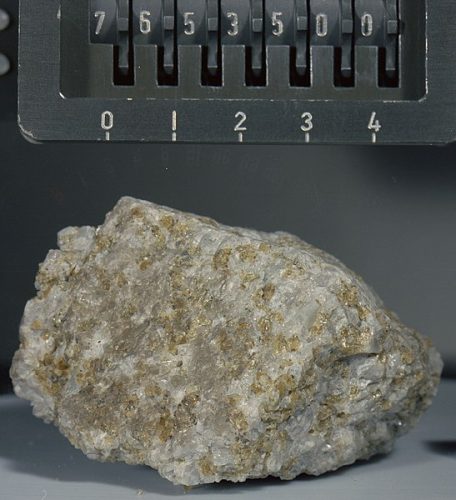
The sample Troctolite 76535

An article published in the journal “Nature Astronomy” reports evidence of significant impacts on the primordial Moon, at least 4.33 billion years ago. A team of researchers carried out a study in particular on the sample cataloged as Troctolite 76535, taken during the Apollo 17 mission in 1972 and brought back to Earth. This specimen contains traces of cubic zirconia, a crystalline form of zirconium oxide that forms above 2370° Celsius, a temperature that could only be reached following violent impacts that could have contributed to the formation of the Moon’s surface.

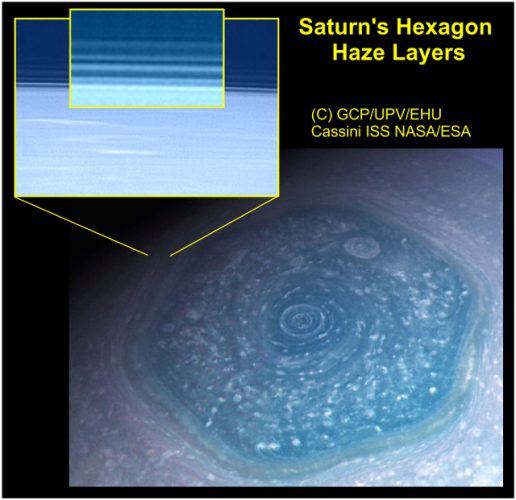
Saturn's hexagon and its layers

An article published in the journal “Nature Communications” reports a study on the stratification of the hexagonal structure of the gigantic hurricane that occupies the planet Saturn’s north pole. A team of researchers led by Professor Agustín Sánchez-Lavega of the University of the Basque Country used data collected by the Cassini space probe and the Hubble space telescope to understand that it’s a system composed of at least seven layers of haze with an extension of over 300 kilometers. The study also allowed to discover that those layers contain microscopic frozen particles composed of hydrocarbons such as acetylene, propane, propine, diacetylene, and butane.

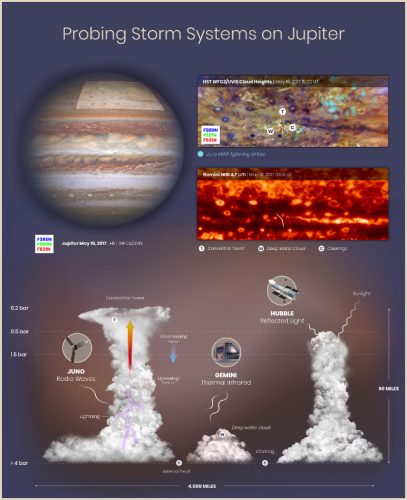
A graphic of the combined observations of Jupiter

An article published in “The Astrophysical Journal Supplement Series” reports the results of a series of combined observations of the planet Jupiter. A team of researchers led by Michael Wong of the University of California, Berkeley, used data collected by the Hubble Space Telescope, the Gemini Observatory in Hawaii and NASA’s Juno space probe to obtain a broader picture of various phenomena taking place in Jupiter’s atmosphere. Storms include the Great Red Spot, which the combined observations help us understand better.

Geological feature in Hellas Planitia (Image NASA JPL-Caltech UoA Matt Balme & William McMahon)

An article published in the journal “Nature Communications” reports evidence of the existence of a river of a size comparable to that of the great European rivers such as Po and Rhine in the Izola mensa area, an outcrop within the large Hellas Planitia basin on the planet Mars. A team of researchers led by Dr. Francesco Salese and Dr. William McMahon examined high-resolution images captured by NASA’s Mars Reconnaissance Orbiter (MRO) space probe to identify traces of an area where some 3.7 billion years ago there was a large river. The environmental conditions had to be favorable to a constant flow of water for a long period with a hydrological cycle, yet another confirmation that at the time the red planet was similar to Earth.

Artist's concept of the HR 6819 system

An article published in the journal “Astronomy & Astrophysics” reports the discovery of a black hole in a triple system known as HR 6819. A team of researchers led by ESO’s Thomas Rivinius used the FEROS spectrograph on the MPG/ESO 2.2 meter telescope at La Silla to examine that system in a study on binary systems, surprisingly discovering the presence of a third object identified as a black hole. It’s the closest black hole to the solar system, but according to the researchers it could be the tip of the iceberg, and there could be many others like that, as predicted by theoretical models.