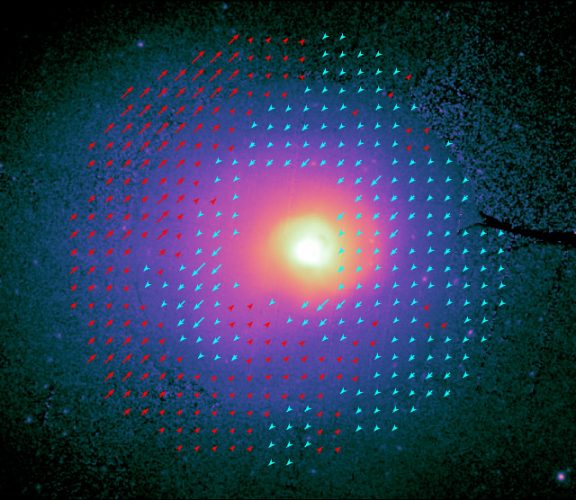
A map of plasma motions in the Perseus and Coma galaxy clusters

An article published in the journal “Astronomy & Astrophyiscs” reports the mapping of the distribution and motion of hot gas within the Perseus and Coma galaxy clusters. A team of researchers led by Jeremy Sanders of the Max Planck Institute for extraterrestrial physics in Garching, Germany, used in particular ESA’s XMM-Newton space telescope to study those two large clusters and detect the gas that, at very high temperatures and in the form of a plasma, shines at X-rays. This mapping offers new information on the formation and evolution of galaxy clusters.

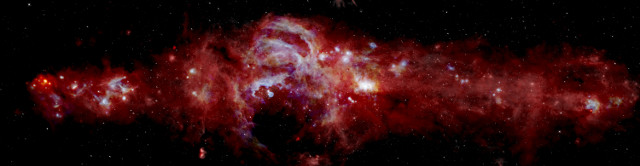
New details of the center of the Milky Way observed by the SOFIA flying telescope

An article submitted for publication in “The Astrophysical Journal” reports the initial results of an investigation about the center of the Milky Way conducted using the SOFIA flying telescope to capture infrared details never seen before and therefore useful for mapping an area 600 light years across. A team of researchers integrated those observations with data previously collected using NASA’s Spitzer space telescope and ESA’s Herschel space observatory obtaining a map of the center of the galaxy useful for example to understand where gas is concentrated which can lead to the new stars’ formation, how some of the most massive stars in the Milky Way formed in a relatively small region or where materials are likely to be devoured by the supermassive black hole at the center of the galaxy.

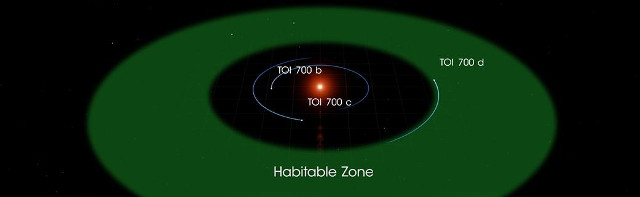
The exoplanet TOI 700 d is the first discovered by the TESS space telescope in its system's habitable zone

Three articles submitted for publication in “The Astrophysical Journal” report various aspects of a study of the TOI 700 system and the discovery of three exoplanets thanks to the observations made by NASA’s TESS space telescope. Several researchers collaborated to confirm the existence of the three exoplanets and to study their characteristics, in particular TOI 700 d, the outermost and the only one of the three to orbit in the habitable zone of its system. Its existence was also confirmed using the Spitizer space telescope making it the first rocky exoplanet discovered by TESS in the habitable zone.

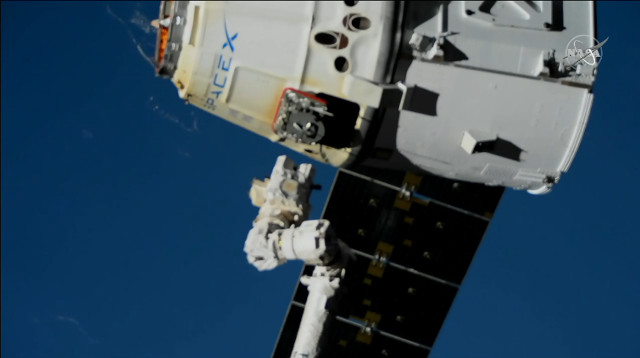
The Dragon cargo spacecraft leaving the International Space Station to end its CRS-19 mission (Image NASA TV)

A little while ago the SpaceX Dragon spacecraft ended its CRS-19 (Cargo Resupply Service 19) mission for NASA splashing down smoothly in the Pacific Ocean almost 500 kilometers (about 300 miles) off the coast of California. The Dragon left the International Space Station a few hours earlier.

Shortly after landing, SpaceX boats went to retrieve the Dragon to transport it to the coast. The cargo brought back to Earth will be delivered to NASA soon, probably tomorrow. The Dragon spacecraft reached the International Space Station on December 8, 2019.

Artist's concept of Sub-Neptune planet (Image NASA/ESA/G. Bacon (STScI)/L. Kreidberg & J. Bean (U. Chicago)/H. Knutson (Caltech) )

An article published in “The Astrophysical Journal Letters” offers an explanation of the abundance of sub-Neptune planets discovered compared to gas giants. A team of researchers led by Edwin Kite of the University of Chicago studied the characteristics of these planets offering as an explanation what they called fugacity crisis in reference to the term that measures how much more easily a gas dissolves into a mixture than it would be expected based on pressure. In the case of the sub-Neptune planets, the their atmosphere’s gas dissolve in the ocean of magma that probably covers the surface of their rocky core.