
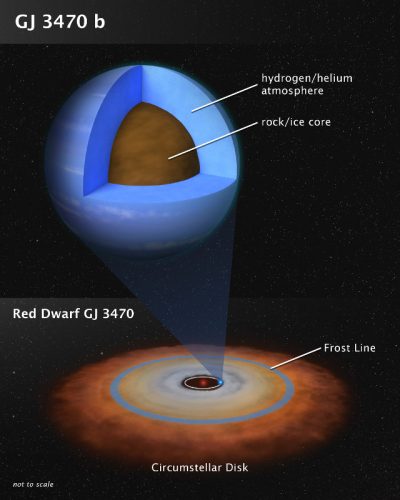
A study of the atmosphere of the exoplanet Gliese 3470 b

NASA used the Hubble e Spitzer space telescopes to study the composition of the atmosphere of Gliese 3470 b, a mini-Neptune that orbits very close to its star, which is a red dwarf but still heats it up to temperatures that are estimated on the surface between 700 and 900 Kelvin. Gaseous planets have an atmosphere composed mainly of hydrogen and helium but normally there are also other heavier elements, with the consequence that various molecules can form, but in Gliese 3470 b those elements are really scarce.

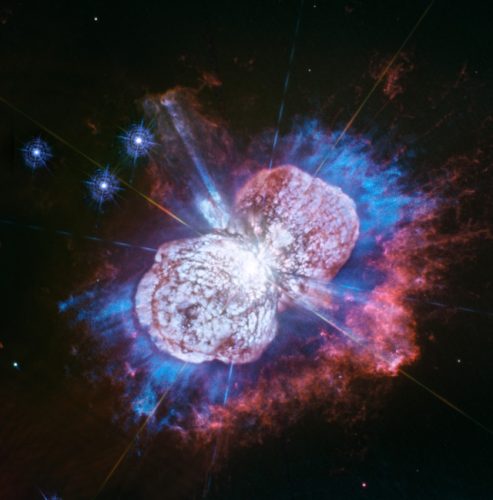
New details of the Eta Carinae system discovered in ultraviolet light

A new image of the Eta Carinae system captured by the Hubble space telescope offers new details of this truly special star system. The Wide Field Camera 3 (WFC3) instrument has in fact made it possible to observe the area in ultraviolet light as well revealing the glow of the magnesium embedded in the hot gas in places where it wasn’t seen before. Every new detail helps to understand the violent processes observed from the Earth for the past two centuries, since the event known as the Great Eruption began.

Three planets, one smaller than the Earth, discovered in the system of the red dwarf L 98-59

An article published in “The Astronomical Journal” reports the discovery of three planets that orbit the star L 98-59, a red dwarf about 35 light-years from Earth. A team of researchers led by Veselin Kostov of NASA’s Goddard Space Flight Center used observations from the TESS space telescope to discover the traces of the three exoplanets. The analysis showed that these are two possible super-Earths and the smallest planet discovered so far thanks to TESS, about 80% of the Earth. The three exoplanets are too close to their star to be in ​​their system’s habitable zone, instead they are in the area called “Venus zone”, where a planet’s atmosphere can heat up in a runaway greenhouse effect.

Origin of a non-repeating fast radio burst pinpointed

An article published in the journal “Science” reports the localization of the point of origin of a non-repeating fast radio burst. A team of researchers led by Keith Bannister of CSIRO (Australia’s Commonwealth Science and Industrial Research Organization) discovered the fast radio burst cataloged as FRB 180924 with the ASKAP radio telescope and then proceeded using the Keck, Gemini South and VLT telescopes to pinpoint its origin in a galaxy about 3.6 billion light years away. Before this result, only the origin of a repeating fast radio burst was pinpointed.

Titan northern hemisphere (Image NASA / JPL-Caltech / Space Science Institute)

At the 2019 Astrobiology Science Conference being held in Bellevue, Washington, Morgan Cable of NASA’s JPL presented the results of a study conducted with other researchers on Titan, Saturn’s largest moon. This team recreated in lab some conditions existing in the lakes of methane and other hydrocarbons of Titan, discovering that a co-crystal of solid acetylene and butane could be produced with the formation of ring-shaped deposits around those lakes similarly to salt deposits which are produced when water evaporates in the Earth’s seas. Those co-crystals could be used by exotic life forms in a way similar to carbon dioxide on Earth.