
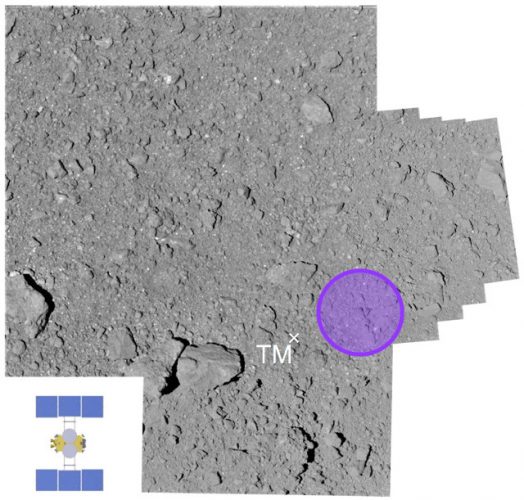
The L08-E1 area on asteroid Ryugu touched by Hayabusa 2 (Image courtesy JAXA)

A few hours ago, the Japanese space probe Hayabusa 2 touched down on the soil of asteroid Ryugu to collect some samples of regolith, the soil’s surface layer, which will be transported back to Earth. This is the first of the three possible attempts and now the Japanese space agency JAXA will have to assess whether to look for another area on the asteroid and proceed with a second attempt.

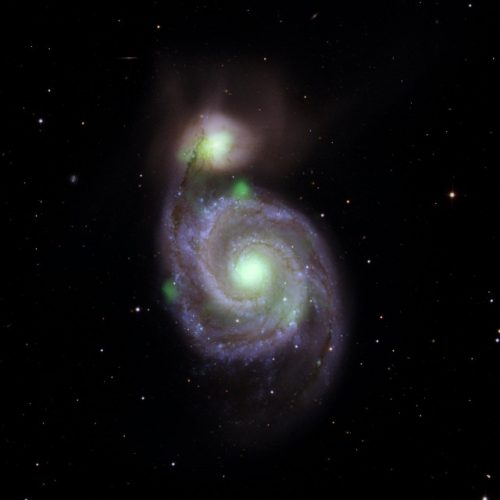
Surprising high-energy X-ray emissions from the Whirlpool Galaxy and its small companion

An article published in “The Astrophysical Journal” presents an in-depth spectral analysis of the two active galactic nuclei and other X-ray sources of the two galaxies that form M51. A team of researchers used NASA’s NuSTAR space telescope to detect high-energy X-ray emissions, which can pass through the layers of dust and gas that orbit the two supermassive black holes at the center of the two galaxies that are interacting in an initial phase of a galactic merger. A surprise came from the emissions of a neutron star in the Whirlpool Galaxy, the larger of the pair.

The deep fractures on the surface of comet 67P/Churyumov-Gerasimenko were generated by shear stress

An article published in the journal “Nature Geoscience” shows an analysis of the erosion processes that have generated deep fractures and faults in the nucleus of comet 67P/Churyumov-Gerasimenko. A team of researchers led by geologist Christophe Matonti of the Aix-Marseille University, France, examined images captured by ESA’s Rosetta space probe’s OSIRIS camera to perform a geological and morphological analysis identifying two fracture formation processes. According to the researchers, surface fractures are generated by temperature changes while the deeper fractures are generated by shear stress.

The starts that form the cosmic river in red with a Gaia map in the background (Image Meingast et al / Gaia DR2 skymap)

An article published in the journal “Astronomy & Astrophysics” reports the discovery of what was called a river of stars, a stream of stars a little over 300 light years away from us that occupies most of the southern sky. Astronomers of the University of Vienna used information collected by ESA’s Gaia space probe and published in the so-called Data Release 2 (DR2) to discover at least 4,000 stars that have been moving together in space since their formation, which was about a billion years ago.

Supernovae and water in rocky planets

An article published in the journal “Nature Astronomy” reports the results of a series of computer simulations conducted to better understand the mechanisms of rocky planets formation. A team of researchers concluded that there are probably two types of planetary systems: those similar to the solar system, with planets containing relatively little water, and those in which there are above all the so-called ocean planets or waterworlds. The difference may have been caused by the presence of a massive star nearby that ejected radioactive materials that have at least partially dried out the planets. This might have led to the emergence of a temperate climate on Earth.