An explanation to the mystery of the stars surrounded by iron dust

An article published in the journal “The Astophysical Journal Letters” reports the study of stars surrounded by iron dust in the Large Magellanic Cloud, one of the Milky Way’s satellite dwarf galaxies. A team of researchers led by Ester Marini, a doctoral student of the “Roma Tre” University, Rome, Italy, used data collected by NASA’s Spitzer Space Telescope to examine these stars that are in a phase of their life in which they lose their outer layers. Normally, that type of stars is surrounded by silicates and the anomaly is interesting because the dusts are important in the formation of new stars and planets as well.

Some details on the geology of Ultima Thule

The Johns Hopkins University Applied Physics Laboratory, which collaborates with NASA at the New Horizons mission, has published a new image of the Kuiper Belt Object cataloged as 2014 MU69 and nicknamed Ultima Thule which offers more details of its geological features. Various pits, the great depression on the smallest lobe, the “collar” that joins the two lobes, clear and dark features will be studied to get answers to the many questions posed after receiving the first images taken by the space probe in its New Year’s Day 2019 flyby.

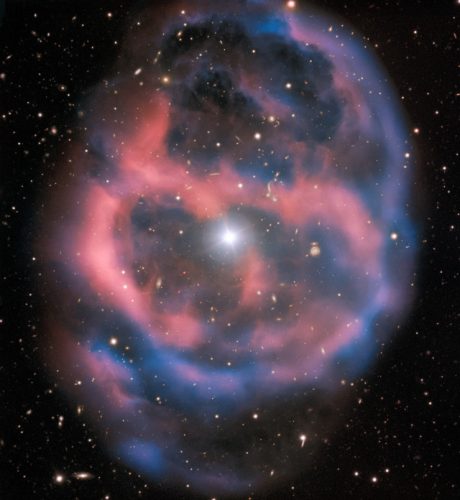
The planetary nebula ESO 577-24 seen in all its beauty by the Very Large Telescope

ESO has published a new image of the planetary nebula ESO 577-24 captured by its Very Large Telescope (VLT) in Chile thanks to its FORS2 instrument, which for almost twenty years has been capturing some of the best astronomical images obtained by the VLT. ESO 577-24 represents the final phase of the life of the star at its center, cataloged as Abell 36, in astronomical terms an instant of agony since its duration is estimated around 10,000 Earth years.

Close-up of Saturn's rings (Image NASA/JPL-Caltech/Space Science Institute)

An article published in “The Astrophysical Journal” reports a precise measurement of the duration of the day on the planet Saturn. The lack of a solid surface with reference points and a magnetic field with unusual characteristics prevented precise measurements, but now a team of researchers led by Christopher Mankovich of the University of California, Santa Cruz, (UCSC) accomplished that feat by exploiting data collected by the Cassini space probe on the effects that the vibrations inside Saturn cause on the oscillation of its gravitational field and consequently also on the rings. The result is that the day on the planet was measured in 10 hours, 33 minutes and 38 seconds.

Evidence of methane rains on Saturn's great moon Titan's north pole

An article published in the journal “Geophysical Research Letters” reports evidence of rainfall on Titan, the largest of Saturn’s moons. A team of researchers led by Rajani Dhingra, a doctoral student in physics at the University of Idaho, examined images captured by the Cassini space probe, finding an anomaly at the north pole of Titan interpreted as a methane rain. This is an indication of the beginning of summer in this moon’s northern hemisphere.