The Dragon cargo spacecraft departing the International Space Station (Photo courtesy Oleg Artemyev)

A few hours ago the SpaceX Dragon spacecraft ended its CRS-14 (Cargo Resupply Service 14) mission for NASA splashing down smoothly in the Pacific Ocean a little more than 420 kilometers (about 326 miles) off the coast of California. The Dragon left the International Space Station a few hours before.

Shortly after landing, SpaceX boats went to retrieve the Dragon to transport it to the coast. The cargo brought back to Earth will be delivered to NASA soon, probably tomorrow. The Dragon spacecraft reached the International Space Station on april 4, 2018.

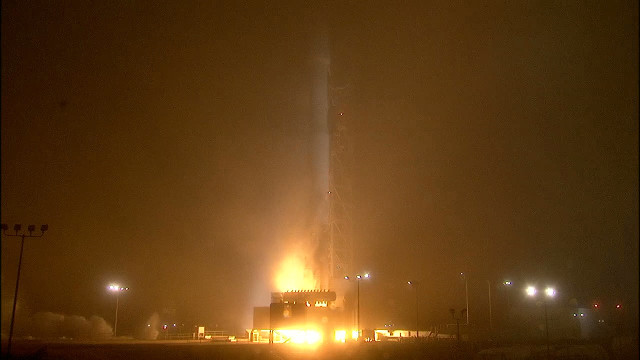
The InSight lander and the MarCO nanosatellites blasting off atop an Atlas V 401 rocket (Image NASA TV)

A few hours ago NASA’s InSight lander was launched together with the two Mars Cube One nanosatellites from the Vandenberg base on an Atlas V 401 rocket. After about 1.5 hours they separated from the rocket’s last stage, called Centaur, and went en route to Mars.

The InSight (Interior Exploration using Seismic Investigations, Geodesy and Heat Transport) mission aims to investigate the geology of the planet Mars. A lander equipped with a seismometer, a thermal sensor and other instruments that will analyze the red planet’s internal structure. This will allow to obtain new data on its formation, also contributing to the existing models on the formation of rocky planets such as the Earth.

The Grand Canyon and Mars

An article published in the journal “Nature Geoscience” describes a research on the possible rainfall that occurred on the planet Mars when it was young. Ramses Ramirez and Robert Craddock, two scientists who have been studying the red planet’s geological and climatic history for years, claim that about 4 billion years ago the climate could be warm and semi-arid with rainfall.

Ganymede (Image NASA)

An article published in the journal “Geophysical Research Letters” describes a new analysis of data collected by NASA’s Galileo space probe during its flybys of Ganymede, one of Jupiter’s great moons. Glyn Collinson of NASA’s Goddard Space Flight Center and some colleagues reused the old flight software to process the data discovering new information on its magnetic field, in particular on its auroras and on the magnetic reconnection phenomena.

the W43-MM1 area (Image courtesy ESO/ALMA/F. Motte/T. Nony/F. Louvet/Nature Astronomy. All rights reserved)

An article published in the journal “Nature Astronomy” describes a research on a region of space about 18,000 light years from the Earth in which a remarkable star formation is being observed, cataloged as W43-MM1. A team of researchers used the ALMA radio telescope to study it and found that more massive stars are forming than predicted by current models.