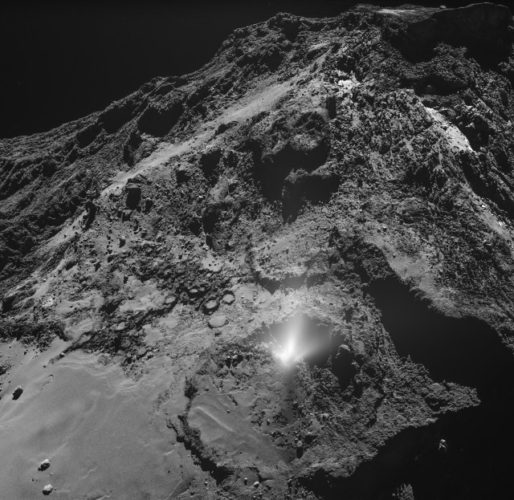
Plume on comet 67P/Churyumov-Gerasimenko (Image ESA/Rosetta/MPS for OSIRIS Team MPS/UPD/LAM/IAA/SSO/INTA/UPM/DASP/IDA)

Two articles published in the journal “Monthly Notices of the Royal Astronomical Society” describe two researches on comet 67P/Churyumov-Gerasimenko based on data collected by ESA’s Rosetta space probe. In an article, a team led by Jürgen Blum of the Technische Universität Braunschweig, Germany, used the data collected to find out how the comet formed. In the other article, a team led by Jessica Agarwal of the Max Planck Institute for Solar System Research in Göttingen, Germany, described a plume on the surface of the comet that could have been generated by pressurized underground gas or by the crystallization of amorphous water ice.

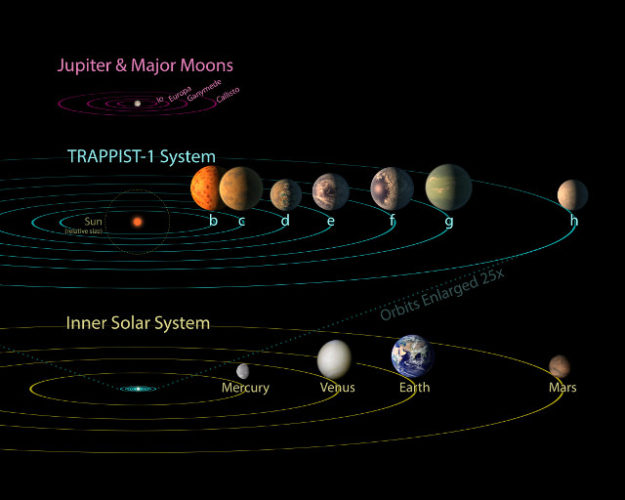
Jupiter and its big moons, the TRAPPIST-1 system and the solar system (Image NASA/JPL-Caltech)

An article published in the journal “Nature Astronomy” describes a research on the magnetic field of the star TRAPPIST-1 and its possible consequences on its inner planets. According to a team of researchers led by the Space Research Institute (IWF) of the Austrian Academy of Sciences (Öaw) at least two of those planets could be heated by the effects of that magnetic field to the point of having a surface composed of a magma ocean.

Artist's concept of ultra-short-period exoplanet and its star (Image NASA’s Goddard Space Flight Center / TESS / MIT / Lincoln Laboratory)

An article accepted for publication in “The Astronomica Journal” describes the discovery of a planet that orbits EPIC 228732031, a star just a little smaller than the Sun. A team of researchers used NASA’s Kepler space telescope to detect traces of the transits of the exoplanet that was called EPIC 228732031b. This type of discovery has become common but in this case it’s a super-Earth whose orbit is very close to its star, so much that its year only lasts 8.9 hours.

Artist's concept of Mars' magnetic tail (Image Anil Rao/Univ. of Colorado/MAVEN/NASA GSFC)

During the 49th annual meeting of the American Astronomical Society’s Division for Planetary Sciences, the results were presented of a research that led to the discovery that the planet Mars has a magnetic tail, called magnetotail, twisted by the interaction with the solar wind. A team led by Dr. Gina DiBraccio of NASA’s Goddard Space Flight Center used data from the MAVEN space probe to discover this phenomenon that according to the researchers is linked to the process known as magnetic reconnection.

The Ernutet crater and the organic materials (Image NASA/JPL-Caltech/UCLA/ASI/INAF/MPS/DLR/IDA)

In the course of the Conference of the American Astronomical Society’s 49th Division for Planetary Sciences Meeting, SwRI (Southwest Research Institute) scientist Simone Marchi presented the results of a study on the origin of the organic compounds discovered on the dwarf planet Ceres by NASA’s Dawn space probe. There were some doubts about the possibility they had formed on Ceres but according to Marchi and his team the evidence they collected that’s the most likely theory.