An area at the base of Mount Sharp (Image NASA/JPL-Caltech/MSSS)

An article published in the journal “Earth and Planetary Science Letters” describes a study of the first samples taken in the lower layers of Mount Sharp on Mars by NASA’s Mars Rover Curiosity. A team of scientists in the ARES Division at NASA’s Johnson Space Center compared the minerals found in the first samples analyzed, which show the different environmental conditions that existed over time.

An area of Margaritifer Terra and Erythraeum Chaos (Image ESA/DLR/FU Berlin, CC BY-SA 3.0 IGO)

ESA has released new images of a crater with a diameter of about 70 kilometers in the region of the planet Mars called Margaritifer Terra. This is a composite of two images captured by the Mars Express Space space probe’s High Resolution Stereo Camera (HRSC) instrument almost exactly 10 years away in March 2007 and February 2017. The crater and the surrounding area show yet again evidence of the presence of liquid water in Mars’ distant past.

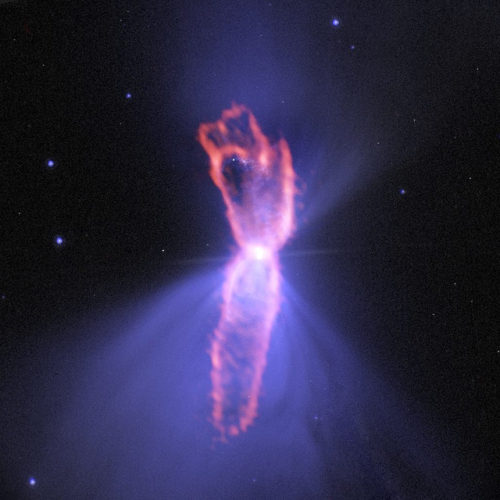
The Boomerang Nebula seen by ALMA and Hubble (Image ALMA (ESO/NAOJ/NRAO); NASA/ESA Hubble; NRAO/AUI/NSF)

An article published in “The Astrophysical Journal” describes a research about the Boomerang Nebula, described as the coldest spot in the universe. A team led by Raghvendra Sahai of NASA’s Jet Propulsion Laboratory used the ALMA radio telescope to understand why the outflow of materials from the star at the center of the nebula is expanding very quickly. According to the astronomers there’s a companion and the gravitational interactions between the two stars accelerated that outflow.

Artist's concept of the star KELT-9 and the planet KELT-9b (Image NASA/JPL-Caltech)

An article published in the journal “Nature” describes the study of the planet KELT-9b. This is an extreme case of hot Jupiter, a gas giant planet like Jupiter so close to its star to be considerably heated up. KELT-9b has an estimated surface temperature in the area exposed to its star that can exceed 4,600 Kelvin, so much that its atmosphere is likely to be dissipating in space and may have a tail similar to that of comets.