Jupiter's South Pole (Image NASA/JPL-Caltech/SwRI/MSSS/Betsy Asher Hall/Gervasio Robles)

Two articles published in the journal “Science” and a special issue of the journal “Geophysical Research Letters” describe various researches about the planet Jupiter based on data collected by NASA’s Juno space probe. Many scientists participated in one or more of those researches, each focusing on a phenomenon in progress on Jupiter and in the area of ​​influence of its magnetic field, with several news that sometimes are surprising.

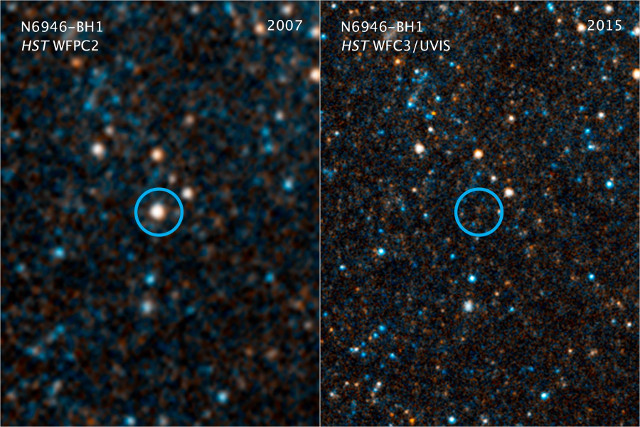
The area where the star N6946-BH1 used to be before and after its disappearance (Image NASA/ESA/C. Kochanek (OSU))

An article published in the journal “Monthly Notices of the Royal Astronomical Society” describes the discovery of a massive star called N6946-BH1 that collapsed and seems to have formed a black hole directly without exploding into a supernova. A team of astronomers led by Christopher Kochanek used the Large Binocular Telescope (LBT) in Arizona and NASA’s Hubble and Spitzer space telescopes to observe for the first time this phenomenon, which could explain why there are less supernovae than expected.

Artist's concept of galaxies merging near a quasar (Image MPIA using material from the NASA/ESA Hubble Space Telescope)

An article published in the journal “Nature” describes the discovery of four galaxies that are very ancient, so much that they formed less than a billion years after the Big Bang. A very high stellar formation rate was observed within them. A team of astronomers led by Roberto Decarli of the Max Planck Institute for Astronomy discovered by chance these four galaxies, noting that they were close to as many quasars.

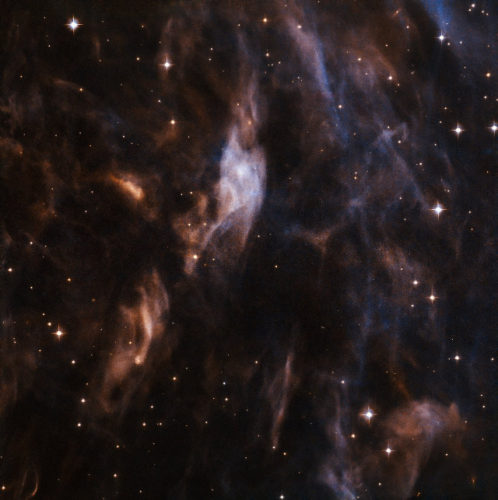
A part of the Sh2-308 nebula (Image ESA/Hubble & NASA)

An image captured by the Hubble Space Telescope shows part of a nebula called Sh2-308 surrounding the star EZ Canis Majoris, a Wolf-Rayet star, a rare type of very massive star, over twenty times the mass of the Sun, and very hot that emits very strong solar winds. The star and the nebula are closely linked because the very strong solar winds push large amounts of ionized hydrogen that form a kind of temporary bubble around it.

The Fomalhaut system seen by ALMA and Hubble (Image ALMA (ESO/NAOJ/NRAO), M. MacGregor; NASA/ESA Hubble, P. Kalas; B. Saxton (NRAO/AUI/NSF))

Two articles to be published in “The Astrophysical Journal” describe two studies concerning the ring of debris surrounding the star Fomalhaut. An international team of astronomers used the ALMA radio telescope to get the first complete image of those debris, which are probably the product of a series of collisions among comets near the outer edges of that solar system. Carbon monoxide and carbon dioxide have also been found in abundance.