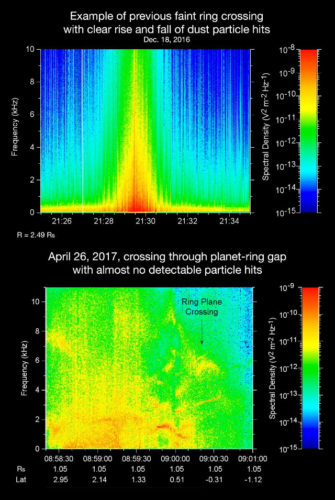
Some data from the RPWS instrument (Image NASA/JPL-Caltech/University of Iowa)

The first results of the analysis of the data collected by the Cassini space probe during its dive into the space between the planet Saturn and its rings on April 26, 2017 provided a remarkable surprise. The researchers discovered that Cassini’s instruments recorded very few particles during the crossing of that space and all of them were tiny, around a micron across. This is a mystery to which the researchers hope to find an explanation.

The galaxy NGC 5917 (Image ESA/Hubble & NASA)

An image captured by the Hubble Space Telescope of the galaxy NGC 5917 just published shows it on its own. This could be considered normal but this is a special case because it’s a galaxy known mainly for its interaction with a neighbor known as MCG-01-39-003. Those are interacting galaxies, an expression used when there are galaxies that affect each other with their mutual gravity. NGC 5917 and MCG-01-39-003 could end up merging.

The heliosphere according to the latest measurements (Image Dialynas, et al.)

An article published in the journal Nature Astronomy describes a research on the shape of the heliosphere, the “bubble” in which the solar wind density is greater than that of interstellar matter. A team led by Kostas Dialynas of the Academy of Athens used data collected by four space probes – Cassini, the two Voyagers and IBEX (Interstellar Boundary Explorer) – to prove that the heliosphere has an approximately spherical shape and not extended with a tail as seemed much more likely.

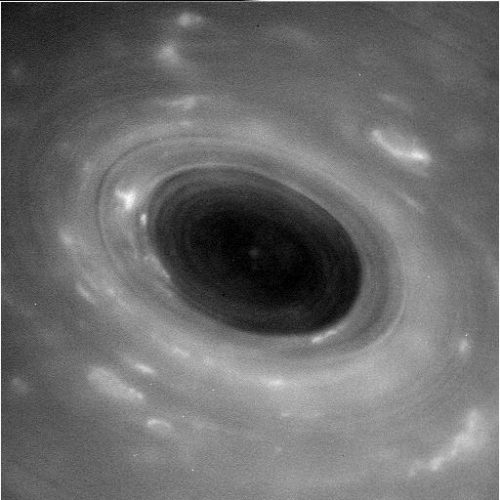
The storm at Saturn's north pole (Photo NASA/JPL-Caltech/Space Science Institute)

NASA started publishing the first photos taken by the Cassini space probe after its descent into the gap between the planet Saturn and its rings. These are the closest photos taken during a risky maneuver for Cassini, performed only because within a few months it will end its mission so it was decided that it’s worth taking risks to collect close-range data.

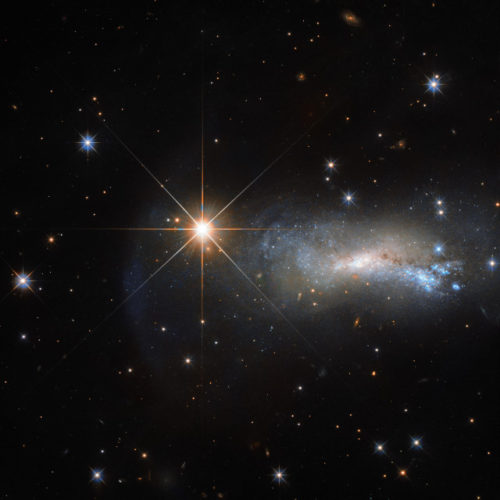
The galaxy NGC 7250 and the star TYC 3203-450-1 (Image ESA/Hubble & NASA)

An image captured by the Hubble Space Telescope portrays the irregular galaxy NGC 7250, along with the star TYC 3203-450-1, which is much closer and thus from the Earth looks much brighter than a whole galaxy. That star’s presence makes studying the galaxy more difficult because its light interferes with NGC 7250’s dimmer light, polluting the observations of an object that’s interesting because of its peculiar characteristics.