Protoplanetary disk with a dust trap seen as a bright ring (Image courtesy Jean-Francois Gonzalez)

An article published in the journal “Monthly Notices of the Royal Astronomical Society” describes a research that provides an explanation for one of the last remaining mysteries about planet formation. An international team of researchers conducted a series of simulations that show that in the protoplanetary disk around a young star dust traps form that accelerate the aggregation of pebble-sized fragments from which planets are born.

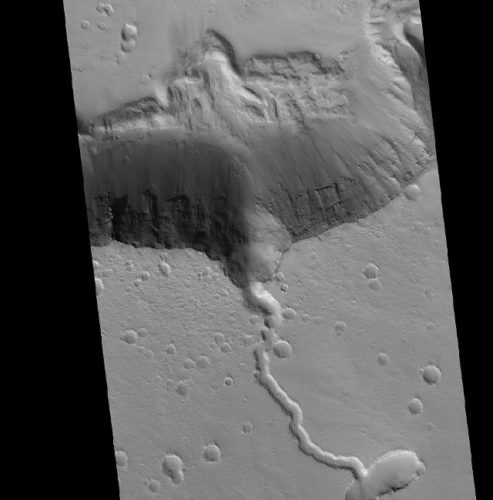
A solidified lava flow over the side of a crater rim of Elysium (Photo NASA HiRISE image, David Susko, LSU)

An article published in the journal “Scientific Reports” describes a research on Elysium Planitia, a volcanic region near Mars’ equator. A team of researchers from Louisiana State University led by David Susko used data collected by the Mars Global Surveyor (MGS), Mars Odyssey Orbiter and the Mars Reconnaissance Orbiter space probes to study the Martian mantle finding some similarities with the Earth’s one and traces of recent volcanic activity.

The Dragon V2 spacecraft presented by Elon Musk (Photo courtesy SpaceX. All rights reserved)

Elon Musk, SpaceX founder and CEO, has announced that his company was hired to send two people on a private journey around the Moon in 2018. Musk didn’t reveal the two persons’ identity nor indicated the journey’s cost but merely stated that they have already paid a substantial deposit. The journey will be made on the Dragon V2 spacecraft, the version developed precisely for manned missions, which will be launched on a Falcon Heavy rocket.

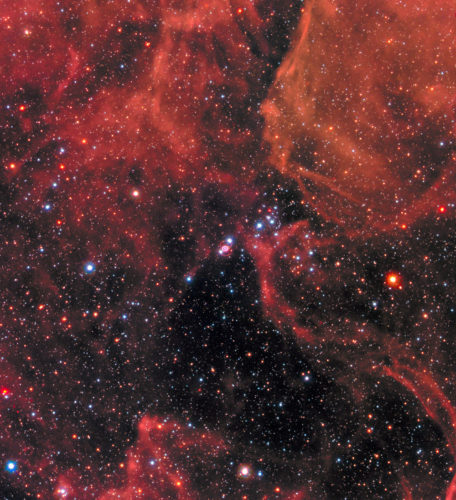
The supernova SN 1987A at the center (Image NASA, ESA, R. Kirshner (Harvard-Smithsonian Center for Astrophysics and Gordon and Betty Moore Foundation), and M. Mutchler and R. Avila (STScI))

In recent days on La Réunion Island a meeting was held to celebrate the 30th anniversary of the sighting of the supernova 1987A (SN 1987A), the brightest of the last four centuries and for this reason a historic event for modern astronomy. For these celebrations scientists from the Hubble and Chandra space telescopes chose an animation derived from the model of a team of astrophysicists from INAF-Osservatorio Astronomico di Palermo, Italy led by Salvatore Orlando.