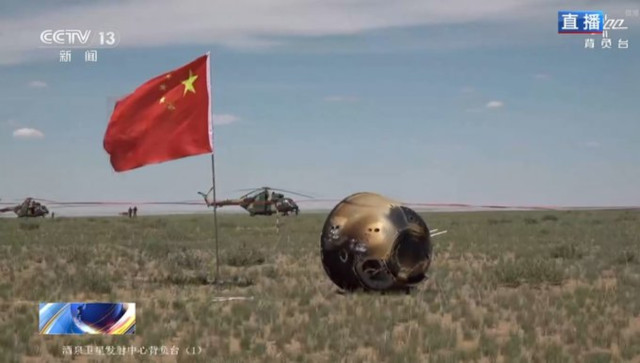
The capsule with the samples from the Chang-e 6 mission after landing (Image courtesy CCTV)

A little while ago, the capsule carrying the Moon samples taken during the Chang’e-6 mission landed in the Siziwang Banner, meaning an autonomous county of Inner Mongolia. The lander with the return module landed on the Moon when in China it was June 2, spent about two days collecting samples, and the return module took off to transport the samples to orbit and start the voyage back to Earth. Recovery personnel found the capsule, which will be transported to a laboratory in Beijing, where operations will begin to open it without contaminating its contents.

The Serpens Nebula observed by the James Webb Space Telescope

An article accepted for publication in “The Astrophysical Journal” reports the first detection of aligned bipolar jets emitted by protostars in the Serpens Nebula. A team of researchers used observations conducted with the James Webb Space Telescope to obtain the details needed to spot these jets. Typically, they have different orientations within a star-forming region but in this case, they are aligned almost perfectly. This suggests that star formation may be at a unique time in its history in the Serpens Nebula and provide crucial information about these processes.

The pair of quasars photographed by the Hyper Suprime-Cam mounted on Subaru Telescope

An article published in the journal “The Astrophysical Journal Letters” reports the discovery of the most distant pair of merging quasars known. A team of researchers combined observations from the Subaru Telescope with the Gemini North Telescope to find traces of this pair of quasars that we see as they were about 900 million years after the Big Bang.
Studying this pair of quasars can offer new insights into the epoch of reionization, the period that began about 400 million years after the Big Bang and was crucial in the history of the universe. That’s the time when the neutral, light-blocking hydrogen was ionized, resulting in the universe becoming the bright place we know today. An article accepted for publication in a journal of the American Astronomical Society offers further analysis based on observations conducted with the ALMA radio telescope.

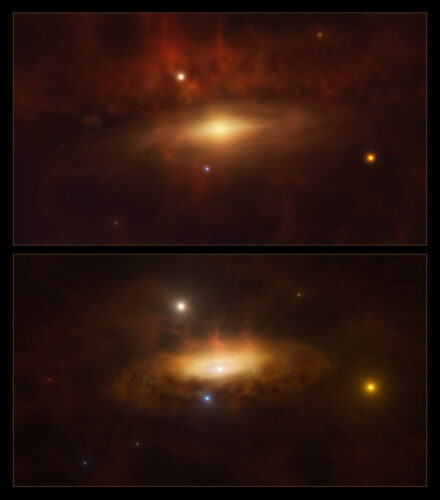
Artist's illustration of two phases of the formation of a disk of gas and dust around the supermassive black hole at the center of the galaxy SDSS1335+0728

An article accepted for publication in the journal “Astronomy & Astrophysics” reports the results of the observation of a new activity of the supermassive black hole at the center of the galaxy cataloged as SDSS J133519.91+072807.4 and called “simply” SDSS1335+0728. A team of researchers used observations conducted with various instruments to observe an increase in this galaxy’s brightness. This already led to its inclusion among those with an active galactic nucleus at the end of 2019.

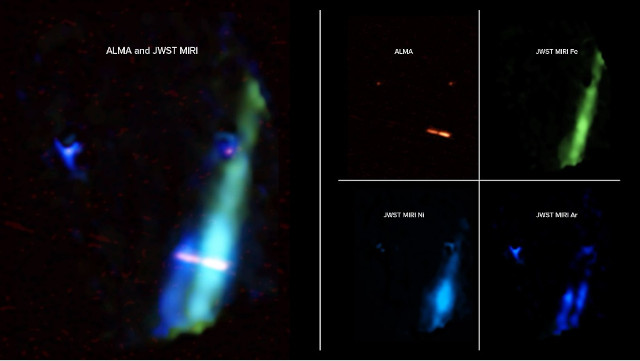
The WL20S system in a combination of ALMA and Webb observations

At the 244th Meeting of the American Astronomical Society, a study was presented of what turned out to be a pair of stars inside the WL20 group, cataloged as WL20S. The authors of this study combined observations conducted with the ALMA radio telescope and the James Webb Space Telescope to obtain the information necessary to establish that in that system there are two young stars, and not one as astronomers thought, which formed between 2 and 4 million years ago. Both stars are surrounded by disks of materials in which there could be planets forming and parallel jets of materials emitted by the two stars.