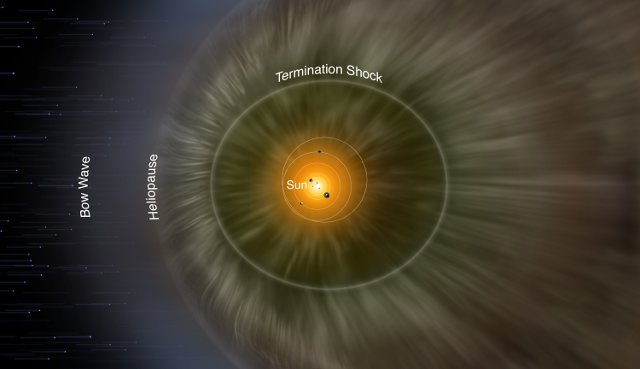
Artistic representation of the heliosphere with its heliopause and termination shock (Image NASA/IBEX/Adler Planetarium)

An article published in the journal “Astrophysical Journal Letters” describes a study that used data from NASA’s IBEX space probe and various simulations of the boundary of the magnetic bubble called the heliosphere, created by the flow of particles emitted by the Sun, to improve our knowledge of the interstellar magnetic field. In particular, this study sought to determine the strength and direction of the magnetic field outside the heliosphere to understand the forces acting in the galactic neighborhood.

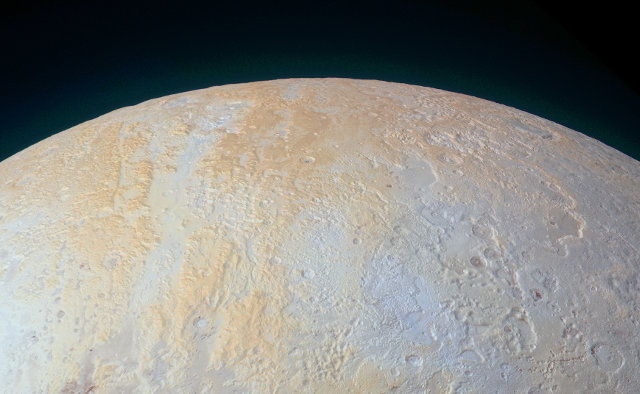
The area around Pluto's North Pole (Image NASA/JHUAPL/SwRI)

NASA’s New Horizons space probe sent photographs of the area around the dwarf planet Pluto’s north pole taken during the extraordinary July 14, 2015 flyby. The images reveal a series of canyons long and wide in the polar area that at its bottom is about 1,200 km (750 miles) wide. It’s part of the region informally called Lowell Regio after the astronomer Percival Lowell, the founder of the observatory where Pluto was discovered.

Field of view of the Parkes radio telescope. On the right two zoom-ins and at the bottom an image from the Subaru telescope (Image courtesy D. Kaplan (UWM), E. F. Keane (SKAO))

An article published in the journal “Nature” describes research that has uncovered the place of origin of a Fast Radio Burst (FRB). These radio signals that last only a few milliseconds are picked up with no phenomenon that might warn about its arrival. An international team of astronomers used observations made by optical and radio telescopes to trace the origin of this phenomenon.

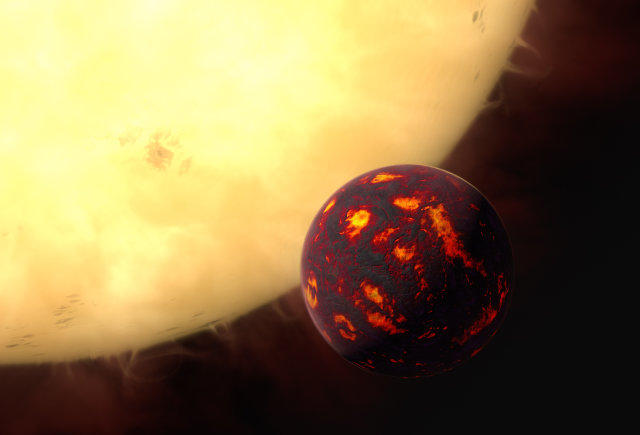
Artist’s impression of the exoplanet 55 Cancri e in front of its parent star (Image ESA/Hubble, M. Kornmesser)

An article published in the journal “The Astrophysical Journal” describes a research on the planet 55 Cancri e focused in particular on its atmosphere. This is the first study of its kind involving a super-Earth and was carried out in an innovative way using the Hubble Space Telescope. 55 Cancri e has already been the subject of several studies and about four years ago was the first super-Earth directly observed.