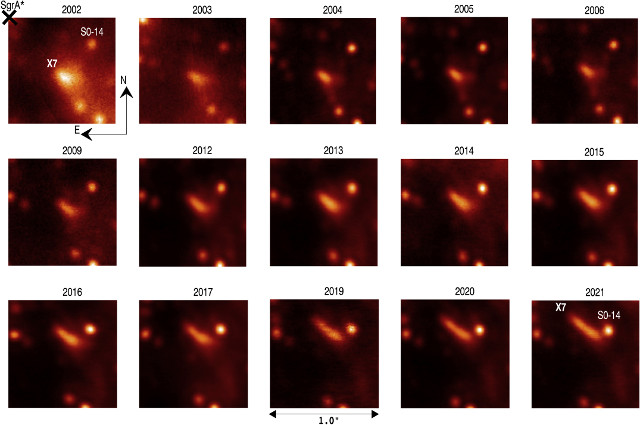
Some images captured by the NIRC2 instrument using adaptive optics showing the evolution of X7 between 2002 and 2021

An article published in “The Astrophysical Journal” reports the results of twenty years of observations of a giant filament of gas and dust that is progressively approaching Sagittarius A*, the supermassive black hole at the center of the Milky Way. A team of researchers from the Keck Observatory and UCLA’s Galactic Center Orbits Initiative (GCOI) used Keck’s OSIRIS and NIRC2 instruments to keep an eye on this filament, cataloged as X7, to study its orbit and shape’s evolution. According to predictions, in 2036, X7 will get close to Sagittarius A* to the point of dissipating and be devoured. This will be a really interesting event to study even more deeply what happens in that really extreme environment.

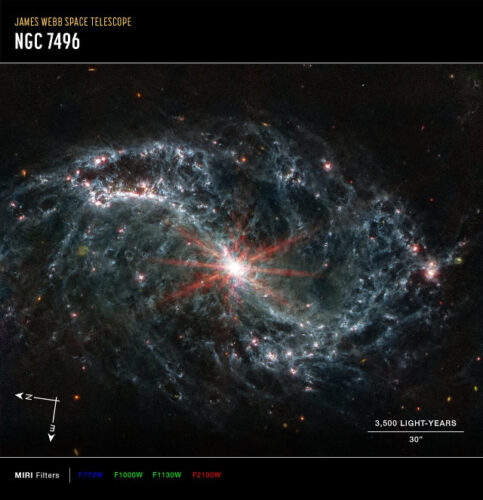
The galaxy NGC 7496 as seen by the James Webb Space Telescope (Image NASA, ESA, CSA, and J. Lee (NOIRLab), A. Pagan (STScI))

A special issue of “The Astrophysical Journal Letters” contains a series of articles reporting the first results of the PHANGS–JWST survey. More than one hundred researchers from the Physics at High Angular resolution in Nearby Galaxies (PHANGS) Collaboration used the James Webb Space Telescope to examine the galaxies M74, NGC 7496, IC 5332, NGC 1365, and NGC 1433. In particular, the Mid-Infrared Instrument (MIRI) made it possible to observe structures within those galaxies in previously unseen detail. The information gathered is valuable for reconstructing star formation processes and the influence they have on the gas surrounding protostars and newborn stars.

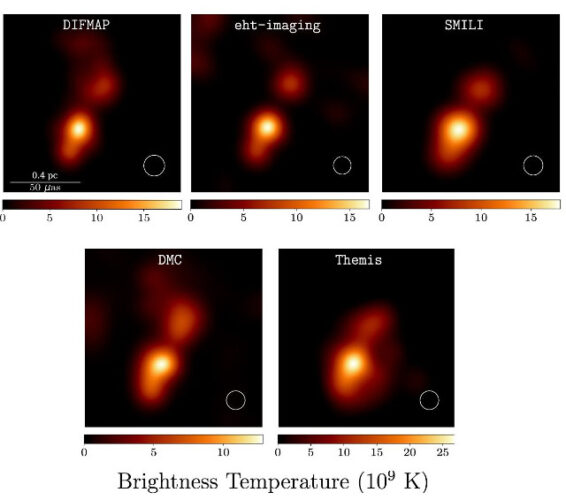
The results of the observations of the quasar NRAO 530 produced using the various methods to processed the data

An article published in “The Astrophysical Journal” reports the study of the quasar NRAO 530 conducted within the EHT (Event Horizon Telescope) project, which uses a combination of radio telescopes around the world to obtain images of areas around supermassive black holes. In this case, these are the innermost areas of NRAO 530, where gas and dust are heated to the point of generating strong electromagnetic emissions. About 7.5 billion light-years from the Earth, it’s the farthest supermassive black hole observed so far by the EHT project. The new details obtained on the structures present in this quasar’s central region are useful to understand the processes taking place in that extreme environment.

The trio SDSSCGB 10189 (Image ESA/Hubble & NASA, M. Sun)

An image captured by the Hubble Space Telescope shows a trio of interacting galaxies. Cataloged as SDSSCGB 10189, the trio is a rare case of three massive, star-forming galaxies less than 50,000 light-years apart. At a galactic level, that’s a very short distance, and that’s why their shape is already distorting.

Galaxy mergers are an important topic of astronomical research and in this case, SDSSCGB 10189 is also an object of study for research on the origins of the so-called Brightest Cluster Galaxies (BCGs), the brightest within their clusters and also the most massive.