The NASA's Orion spacecraft splashing down

A little while ago, NASA’s Orion spacecraft completed its Artemis I mission by splashing down off the coast of the Baja California Peninsula, near Guadalupe Island. It blasted off on November 16 on the new SLS (Space Launch System), also NASA’s. Various ships were in the area to recover the Orion and every piece of hardware that can be recovered, such as the parachutes of the landing system, in order to collect as much data as possible on a critical phase such as the return to Earth.

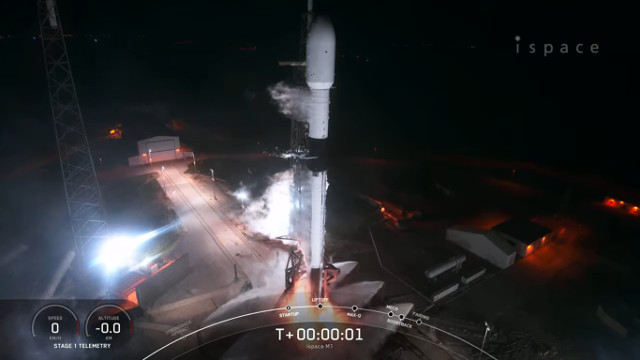
The Hakuto-R Moon lander and the Lunar Flashlight nanosatellite blasting off atop a Falcon 9 rocket (Image SpaceX)

A little while ago, ispace’s Hakuto-R Moon lander and NASA’s CubeSat-class nanosatellite Lunar Flashlight blasted off atop a Falcon 9 rocket from Cape Canaveral. After about 46 minutes, Hakuto-R successfully separated from the rocket’s last stage, and about 7 minutes later, Lunar Flashlight separated as well. Hakuto-R also carries two small rovers built by the United Arab Emirates and Japan. The route of what is called Hakuto-R Mission 1 will take about five months to get the lander to the Moon, where it will attempt a landing while the nanosatellite Lunar Flashlight will enter lunar orbit in about four months in search of water ice on its surface.

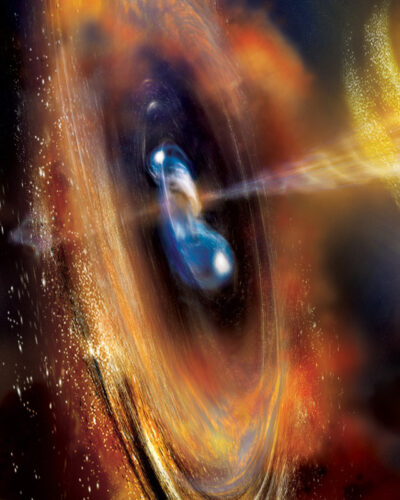
Artist's representation of a merger between two neutron stars (Image A. Simonnet (Sonoma State Univ.) and NASA’s Goddard Space Flight Center)

Three articles published in the journal “Nature” and one article published in the journal “Nature Astronomy” report various aspects of the studies conducted on the out-of-normal gamma-ray burst cataloged as GRB 211211A. Various teams of researchers used observations conducted with a series of ground-based and space telescopes to examine an event that lasted more than two hours after the actual burst. At that time, the gravitational wave detectors were not active but the event’s characteristics indicate that the origin is in a kilonova, a merger between two neutron stars.

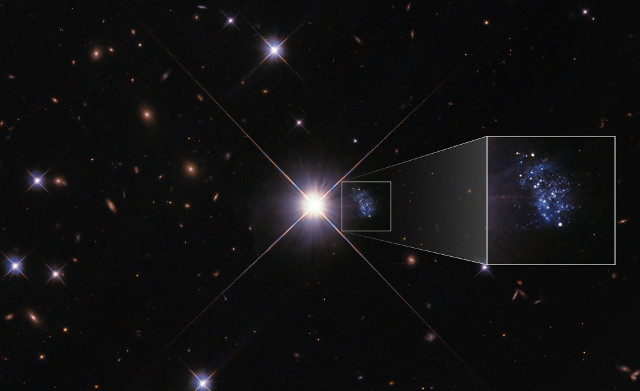
HIPASS J1131–31 / Peekaboo, magnified in the inset (Image Science: NASA, ESA, Igor Karachentsev (SAO RAS) image processing: Alyssa Pagan (STScI))

An article accepted for publication in the journal “Monthly Notices of the Royal Astronomical Society” reports a study of a dwarf galaxy cataloged as HIPASS J1131–31 that is relatively close but has the characteristics of a primordial galaxy. A team of researchers combined observations from various ground-based and space telescopes to confirm its nature, including the Hubble Space Telescope. They nicknamed it Peekaboo because it peeks out from behind a bright star that hid it for a long time and made it difficult to identify. It’s a very small galaxy but its primordial characteristics make it interesting for astronomers.

The SMACS-J0723.3-7327 galaxy cluster seen by the James Webb Space Telescope

An article published in “The Astrophysical Journal Letters” reports the results of the most complete analysis of the so-called intracluster light conducted so far. Mireia Montes and Ignacio Trujillo of the Instituto de Astrofísica de Canarias (IAC) used the James Webb Space Telescope to observe the SMACS-J0723.3-7327 galaxy cluster. In particular, they exploited the NIRCam instrument to detect intracluster light, which is extremely dim but useful to study galaxy clusters in ways other than visible light observations. These studies are also useful for understanding the distribution of dark matter.