The star getting destroyed in the AT 2020neh event (Image NASA, ESA, Ryan Foley/UC Santa Cruz)

An article published in the journal “Nature Astronomy” reports a study of a so-called tidal disruption event, the destruction of a star by a black hole, in this case, an intermediate-mass black hole candidate. A team of researchers cataloged the event as AT 2020neh and studied it using the Hubble Space Telescope after its discovery, which happened thanks to the Young Supernova Experiment (YSE), a survey conducted using the Pan-STARRS telescopes. Intermediate-mass black holes are rare, at least as far as we know today, so each candidate discovered can offer new information, including on the possibility that they are precursors of supermassive black holes.

The Cone Nebula seen by the FORS2 instrument of VLT (Image ESO)

ESO has released an image of the Cone Nebula captured using the FOcal Reducer and low dispersion Spectrograph 2 (FORS2) instrument mounted on the Very Large Telescope (VLT) as part of the 60th-anniversary celebrations of this astronomical research organization’s creation. The convention to create the European Southern Observatory was signed on October 5, 1962, and led to the construction of state-of-the-art telescopes, also in collaboration with other organizations. 60 years of astronomy are also celebrated with a campaign of observations that among other things captured the image of the Cone Nebula.

The Cygnus "Sally Ride" cargo spacecraf captured by the International Space Station's Canadarm2 robotic arm (Image NASA TV)

Northrop Grumman’s Cygnus spacecraft, launched last Monday, November 7, has just reached the International Space Station and was captured by the Canadarm2 robotic arm. Astronaut Nicole Mann, assisted by her colleague Josh Cassada, will soon begin the slow maneuver to move the Cygnus until it docks with the Station’s Unity module after about two hours.

The Cygnus "Sally Ride" cargo spacecraft blasting off atop an Antares rocket (Image NASA TV)

A little while ago, Northrop Grumman’s Cygnus spacecraft blasted off atop an Antares rocket from the Mid-Atlantic Regional Spaceport (MARS), part of NASA’s Wallops Flight Facility (WFF) on Wallops Island. After about nine minutes it successfully separated from the rocket’s last stage and went en route to its destination. This is the mission called NG-18 or CRS NG-18 to transport supplies to the International Space Station for NASA.

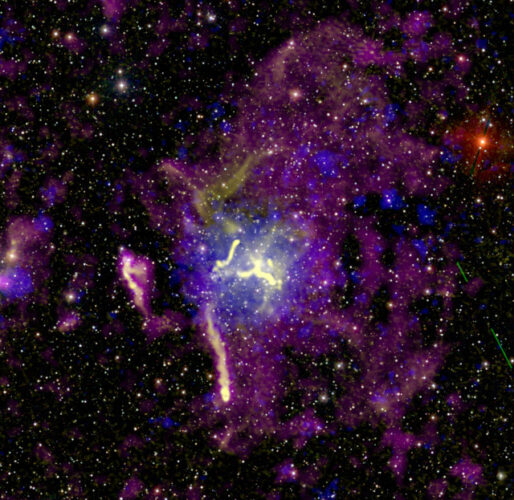
A composite view of the galaxy cluster Abell 2255

An article published in the journal “Science Advances” reports the results of a study of the galaxy cluster Abell 2255 which for the first time detected a radio glow on a scale so large that it surrounded the entire cluster. A team of researchers used the LoFar radio telescope for 18 nights over an area four times the size of the full moon to achieve such a detailed result. According to the researchers, the origin of that emission which is at least 16 million light-years wide is linked to the energy released during the cluster formation.