Asteroids

Asteroid Ryugu (Image courtesy Seiji Sugita et al., Science)

Three articles published in the journal “Science” describe as many researches on asteroid Ryugu. Three teams of researchers used the data collected by the Japanese space agency JAXA’s Hayabusa2 space probe to obtain the first precise descriptions of the characteristics of Ryugu and in particular its geology. The portrait that comes out is that of a porous asteroid containing hydrated minerals and at the same time very little water. It probably formed by a part of the debris of a larger asteroid that got destroyed.

Asteroid Bennu revealed various surprises

Seven articles published in the magazines “Nature”, “Nature Astronomy”, “Nature Geoscience” and “Nature Communications” report a series of research results about asteroid Bennu. Hundreds of scientists used data gathered by NASA’s OSIRIS-REx space probe to study in particular various aspects of Bennu’s geology. The results will be useful in various other studies, from those about the origin of life’s building blocks that sowed the Earth to those about the solar system’s formation, including some practical ones such as the search for an area on which OSIRIS-REx can descend to take samples to assessments of the danger posed by asteroids such as Bennu.

Circular features and pits on Ultima Thule

NASA and The Johns Hopkins University Applied Physics Laboratory have published some photos of the Kuiper belt object cataloged as 2014 MU69 and nicknamed Ultima Thule taken by the New Horizons space probe’s LORRI camera only six minutes before its maximum approach. At only 6,628 kilometers (4,109 miles) from it and at its very high speed there was the risk of not being able to perfectly aim at a such a small object but the operation was successful.

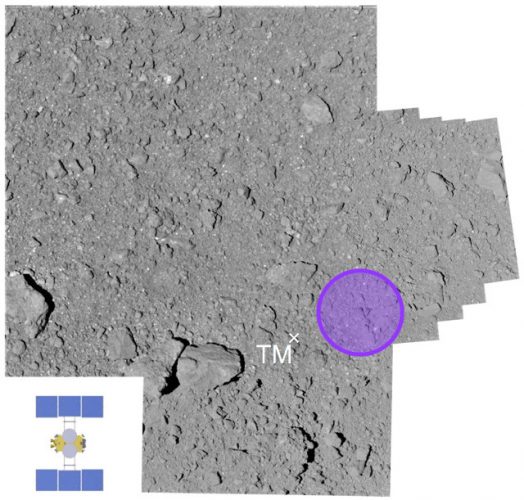
The L08-E1 area on asteroid Ryugu touched by Hayabusa 2 (Image courtesy JAXA)

A few hours ago, the Japanese space probe Hayabusa 2 touched down on the soil of asteroid Ryugu to collect some samples of regolith, the soil’s surface layer, which will be transported back to Earth. This is the first of the three possible attempts and now the Japanese space agency JAXA will have to assess whether to look for another area on the asteroid and proceed with a second attempt.

Ultima Thule has a shape even stranger than expected

NASA and the Johns Hopkins University Applied Physics Laboratory have published new images of the Kuiper belt Object cataloged as 2014 MU69 and nicknamed Ultima Thule along with animations that show new details of its shape. A sequence of 14 images captured by the New Horizons space probe during its January 1, 2019 flyby shows that the this object’s two lobes are not vaguely spherical as it seemed but in particular the larger one is definitely flat, to the point that it was compared to a pancake, and it’s not clear why it has that shape.