Asteroids

Artist's impression of 2004 EW95 (Image ESO/M. Kornmesser)

An article published in the journal “The Astrophysical Journal Letters” describes the study of an asteroid cataloged as 2004 EW95 which confirmed it has anomalous characteristics, being the first in the Kuiper belt to show a considerable carbon content. A team of astronomers used ESO’s VLT to study an asteroid that probably formed in the belt between Jupiter and Mars before being pushed to the outer solar system.

Gaia's sky DR2 map (Image ESA/Gaia/DPAC)

ESA has published the second 3D map of the Milky Way and neighbouring galaxies obtained from the Gaia space probe, the most detailed of this type ever produced. This catalog, built thanks to what was called Data Release 2 (DR2), greatly expands the first map released by ESA in September 2016.

The Gaia space probe was launched on December 19, 2013 with the aim of creating a highly accurate 3D map of the Milky Way’s stars but also to catalog billions of other celestial objects, not only stars but also galaxies. Gaia began its scientific activity in July 2014, the first map included data collected until September 2015, the DR2 includes the following 8 months of observations.

Almahata Sitta meteorite fragment

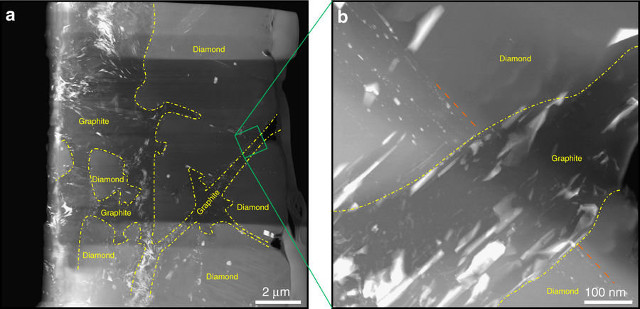
An article published in the journal “Nature Communications” describes a study of microscopic diamonds discovered inside the Almahata Sitta meteorite, a fragment of a larger meteorite exploded in the Earth’s atmosphere on October 7, 2008. A team of researchers analyzed those diamonds concluding that they contain compounds that can only form within a planet, so they must be the remnants of a lost planet with a size between that of Mercury and Mars.

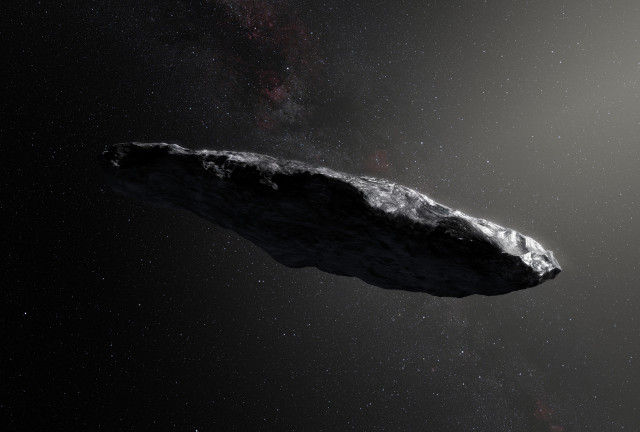
Artist's concept of the interstellar asteroid 'Oumuamua (Image European Southern Observatory/M. Kornmesser)

An article published in the journal “Monthly Notices of the Royal Astronomical Society” describes a research on the interstellar asteroid 1I/2017 U1, commonly known as ‘Oumuamua. A team of researchers tried to understand the implications of its passage in the solar system for planetary dynamics and the formation of planetesimals, the small celestial bodies that can accumulate materials to become planets. ‘Oumuamua could be a fragment of one ejected from its system and some clues suggest that its nature is cometary rather than asteroidal.

Artist's concept of New Horizon's Ultuma Thule flyby (Image NASA/JHUAPL/SwRI/Steve Gribben)

NASA has announced that it chose Ultima Thule as a nickname for 2014 MU69, the Kuiper Belt Object that represents the next target for its New Horizons space probe. In recent months, the mission team asked for suggestions on the Internet and then opened a ballot allowing to select the favorite among the nicknames selected among the thousands of proposals. The result is not an official name, which must be ratified by the International Astronomical Union (IAU), because it’s not clear if Ultima Thule is a single object.