Asteroids

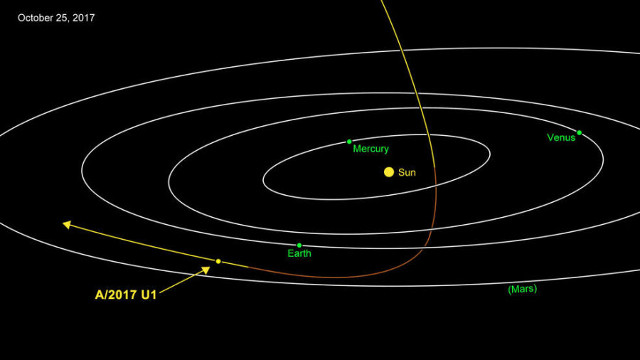
Hyperbolic trajectory of ʻOumuamua

An article published in the journal “Nature Astronomy” describes a research on the tumbling of the interstellar asteroid 1I/2017 U1, commonly known as ‘Oumuamua. According to a team of astronomers led by Queen’s University Belfast, that motion is due to an impact with another object that occurred before it was ejected from its solar system and could continue for at least another billion years.

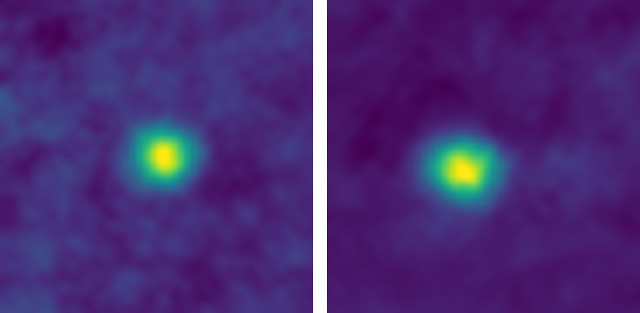
False-color photo of 2012 HZ84 and 2012 HE85 (Image NASA/JHUAPL/SwRI)

NASA has published some photos taken by its New Horizons space probe’s LORRI instrument in December 2017. During the course of its journey that will lead to the object called 2014 MU69’s flyby, New Horizons took photos that beat the record that belonged to Voyager 1 for the farthest photo ever taken from Earth capturing images of the open stellar cluster called Wishing Well and two Kuiper Belt Objects called 2012 HZ84 and 2012 HE85.

The interstellar asteroid 'Oumuamua seen by the William Herschel Telescope at La Palma (Image courtesy A. Fitzsimmons, QUB/Isaac Newton Group, La Palma)

An article published in the journal “Nature Astronomy” describes the results of a spectroscopic analysis and thermal modeling of the interstellar asteroid 1I/2017 U1 ‘Oumuamua. A team of astronomers led by Professor Alan Fitzsimmons and Dr. Michele Bannister from the School of Mathematics and Physics at Queen’s University Belfast concluded that, due to its exposure to cosmic rays, a superficial layering of organic and insulating materials occurred on the asteroid and it might contain ice.

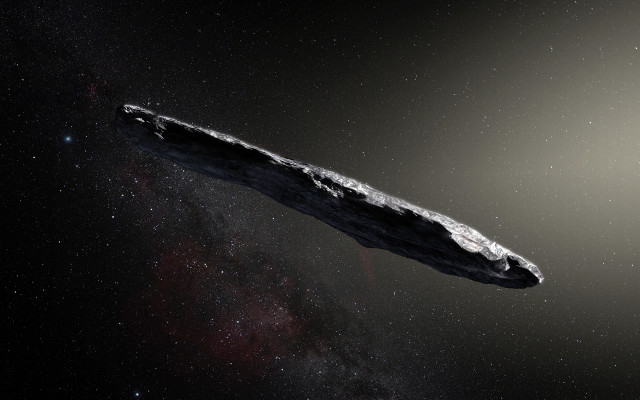
Artist's impression of interstellar asteroid 'Oumuamua (Image ESO/M. Kornmesser)

An article published in the journal “Nature” describes the observations carried out on ‘Oumuamua, the named given to the interstellar asteroid whose discovery was announced only a few weeks ago. It was designated as A/2017 U1 but after the creation of a new class of objects for interstellar asteroids its designation was modified into 1I/2017 U1. Observations with ESO’s VLT (Very Large Telescope) and other telescopes showed that it’s likely dense, rocky, reddish and with a very elongated shape.

A/2017 U1's trajectory through the solar system (Image NASA/JPL-Caltech)

The announcement of the discovery of a possible asteroid coming from another solar system is a big deal. Named as A/2017 U1, it was detected on October 19 by the Pan-STARRS 1 telescope in Hawaii, part of a sky observation system normally used to detect celestial bodies of various kinds. Its motion seems incompatible with the trajectories of asteroids and comets gravitationally bound to the Sun so it could be the first celestial body discovered that came from another star, perhaps Vega.