
Asteroids

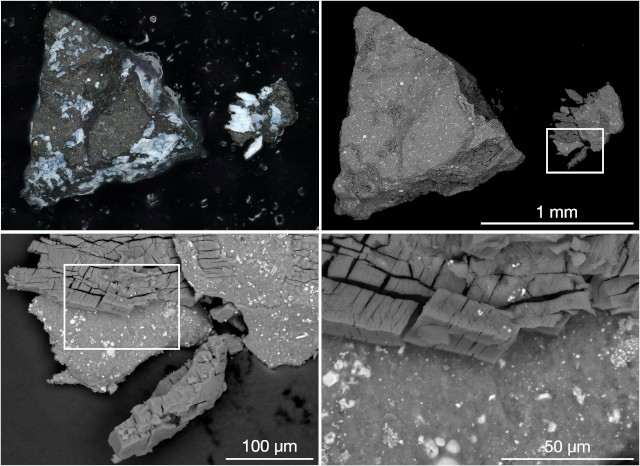
At the top left a sample taken from the asteroid Bennu and in the subsequent panels increasingly zoomed views of a fragment that broke off along a bright vein that contains phosphate, captured under an electron microscope

An article published in the journal “Meteoritics & Planetary Science” reports the results of the preliminary analysis of the samples of material from asteroid Bennu brought back to Earth by NASA’s OSIRIS-REx space probe. A team of researchers conducted morphological and chemical analyzes of the samples, finding a lot of carbon and nitrogen together with organic compounds, all very important components for life forms of the Earth’s type.

The surprise came from the discovery of magnesium-sodium phosphate, which wasn’t detected by the instruments aboard OSIRIS-REx. This compound forms in water-rich environments and suggests that Bennu may be a fragment of a primordial world that had an ocean. The researchers mentioned Enceladus, Saturn’s moon with a subterranean ocean where sodium phosphate was found, and suggest a possible link to Bennu.

Magnetite particles cut from an asteroid Ryugu's sample

An article published in the journal “Nature Communications” reports the results of tests conducted on samples from the asteroid Ryugu brought back to Earth by the Japanese space agency JAXA’s Hayabusa 2 space probe. A team of researchers led by Professor Yuki Kimura of Hokkaido University found traces of the effects probably caused by the bombardment of micrometeorites.

In particular, the technique called electron holography made it possible to discover that the tiny grains called framboids, composed of magnetite, completely lost the magnetic properties they normally have. According to Professor Kimura, this type of study can also be useful for estimating the degradation caused by interplanetary dust on spacecraft.

Artist’s impression of the white dwarf WD 0816-310 with its magnetic field and the debris that surrounds it (Image ESO/L. Calçada)

An article published in “The Astrophysical Journal Letters” reports the results of a study of the white dwarf cataloged as WD 0816-310 and of what was defined as a scar on its surface, left by the materials of a large asteroid that got swallowed. A team of researchers used ESO’s VLT (Very Large Telescope) in Chile to obtain the information necessary to identify the metallic elements that form that scar and its concentration in a specific area, which is one of its magnetic poles. This result offers new insights into the evolution of planetary systems after the death of their star.

Artist's impression of a dust-generating Kuiper Belt collision (Image courtesy Dan Durda, FIAAA)

An article published in “The Astrophysical Journal Letters” reports a study of the presence of dust in the Kuiper Belt which suggests that it may be much more extended than previously thought or that there’s a second Belt outside the known one. A team of researchers used detections conducted with NASA’s New Horizons space probe’s Venetia Burney Student Dust Counter (VBSDC, or simply SDC) instrument to support these possibilities. That’s because current models indicate that dust density should decrease in the area where New Horizons is traveling, where detections are higher than expected.

The Psyche space probe blasting off atop a Falcon Heavy rocket (Image NASA TV)

A little while ago, NASA’s Psyche space probe blasted off atop a SpaceX Falcon Heavy rocket from the Kennedy Space Center. After just over an hour, it successfully separated from the rocket’s last stage and set off on its route that will take it into deep space, towards asteroid 16 Psyche, which it will reach towards the end of July 2029 to study its structure composed mainly of iron-nickel.

Within the asteroid belt between Mars and Jupiter and right now about 3.6 billion kilometers away from Earth, asteroid 16 Psyche is one of the largest known. It’s an M-type asteroid, the type with the highest metal content. It has an irregular shape with a maximum length of almost 280 kilometers, which brings it close to the size of a dwarf planet.