Asteroids

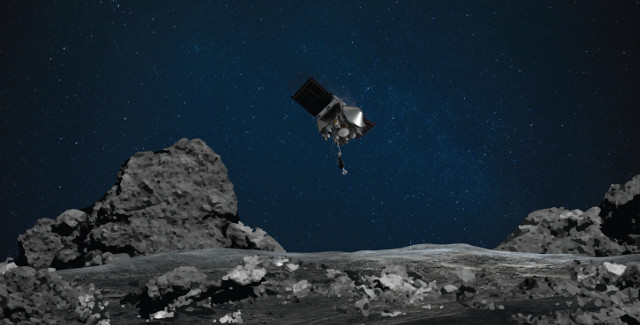
Artist's concept of OSIRIS-REx descending to Bennu's surface (Image NASA/Goddard/University of Arizona)

A few hours ago NASA’s OSIRIS-REx space probe descended to the surface of the asteroid Bennu to take soil samples in what was called TAG (Touch-And-Go). The selected area is in a crater that was named Nightingale with a diameter of about 16 meters in Bennu’s northern hemisphere. The operation was carried out fully automatically because there’s an 18.5 minute delay in communications due to the fact that OSIRIS-REx is about 334 million kilometers from Earth. If the result is satisfactory, this part of the mission will be over.

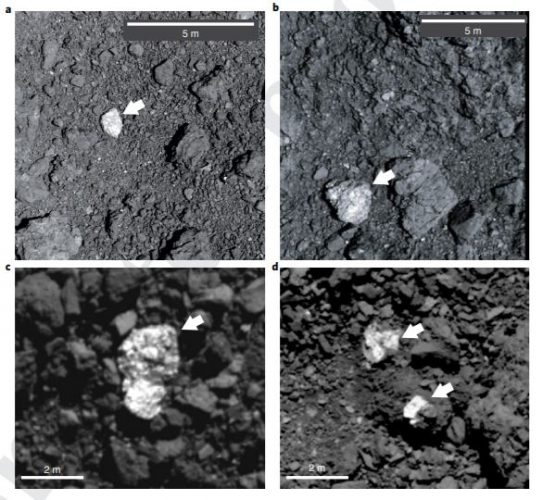
Bright boulders on asteroids Ryugu and Bennu

Three articles published in the journal “Nature Astronomy” report the results of as many researches on asteroids Ryugu and Bennu, which are being explored respectively by JAXA’s Hayabusa 2 and NASA’s OSIRIS-REx space probes. The two asteroids already showed some similarities and, in a news & views editorial, Maria Cristina De Sanctis talks about the catastrophic events that might have generated them and the bright rocks discovered on the surface of both despite their dark color. Catastrophic events are also the object of the other two articles, and in the one focused on Bennu, there are indications that some rocks on its surface come from Vesta, one of the largest objects in the asteroid belt between Mars and Jupiter.

The environment around asteroid Bennu shortly after the ejection occurred on August 28, 2019

A special collection of articles published in “Journal of Geophysical Research: Planets” reports the results of various researches on asteroid Bennu, in some cases already published in recent months. Various researchers used data collected by NASA’s OSIRIS-REx space probe getting some surprises about what happens on Bennu such as the loss of materials being ejected into space. Possible causes include meteoroids, thermal stress, and the ricochet of particles that fall back to the surface then bounce back into space. Bennu’s activity could only be noticed by a nearby space probe, and this raises the question of the possible activity of other asteroids.

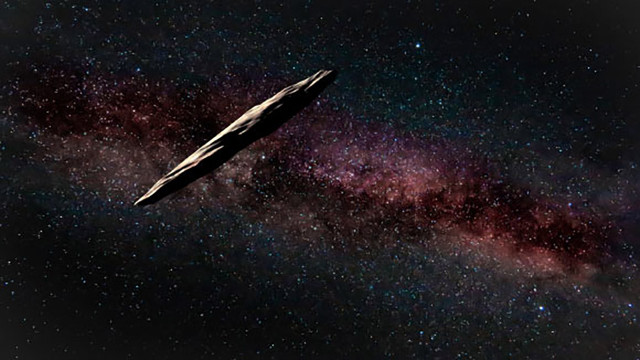
Artist's concept of the interstellar asteroid 'Oumuamua (Image courtesy The international Gemini Observatory/NOIRLab/NSF/AURA artwork by J. Pollard)

An article published in “The Astrophysical Journal Letters” reports a study on the interstellar asteroid 1I/2017 U1, known as ‘Oumuamua, that offers evidence that it’s not some sort of hydrogen iceberg. Abraham Loeb of the Center for Astrophysics | Harvard & Smithsonian (CfA) and Thiem Hoang of the Korea Astronomy and Space Science Institute (KASI) examined the premise of the study that proposed that possibility, that an object composed mostly of molecular hydrogen could form within a giant molecular cloud and be pushed in interstellar space. The researchers concluded that various processes would cause the sublimation of molecular hydrogen, so an iceberg probably couldn’t be formed or would be destroyed by the stars that formed in the same molecular cloud before it could even end up in interstellar space.

IIE iron meteorite sample (Photo courtesy Carl Agee, Institute of Meteoritics, University of New Mexico)

An article published in the journal “Science Advances” reports the results of sophisticated analyzes indicating that IIE iron meteorites are fragments of a planetesimal that had a differentiated structure. A team of researchers conducted various types of tests that gave these results about meteorites called achondrites, composed of materials that were subjected to melting, differentiation, and crystallization. The difference compared to chondrites, meteorites composed of undifferentiated materials, shows that the objects they come from formed and evolved in different ways in space and time.