
Asteroids

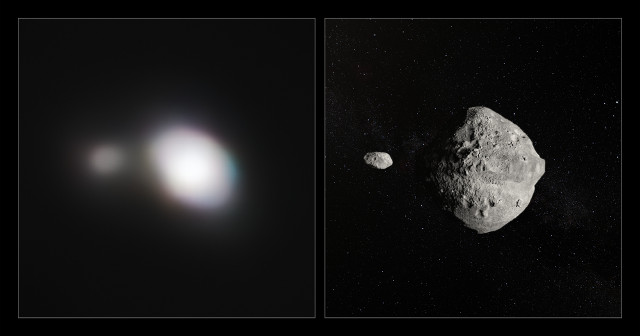
The asteroid 1999 KW4 photographed by the SPHERE instrument

ESO has published photos of the asteroid 1999 KW4 taken using the SPHERE instrument mounted on the VLT in Chile. This is part of a campaign of observations coordinated by the International Asteroid Warning Network (IAWN), which followed the UN recommendations to set up the control of potentially dangerous asteroids. 1999 KW4 passed 5.2 million kilometers from the Earth on May 25, 2019, an absolutely safe distance but it was a good opportunity to assess the possibility of keeping an eye on the trajectory of what’s actually a double asteroid even using an instrument designed to photograph exoplanets.

Ultima Thule image on the cover of Science (Image NASA/Johns Hopkins University Applied Physics Laboratory/Southwest Research Institute/Roman Tkachenko)

An article published in the journal “Science” reports the initial results of the exploration of the Kuiper Belt Object 2014 MU69 nicknamed Ultima Thule by NASA’s New Horizons space probe. There are no particular surprises after the ones arrived thanks to the first images sent to the Earth but the following high-resolution ones along with spectrometric data and other data sent allowed to put together some more details about its characteristics from the mission team.

Artist's concept of a planetesimal orbiting the white dwarf SDSS J122859.93+104032.9 (Image courtesy University of Warwick/Mark Garlick)

An article published in the journal “Science” reports the discovery of what’s probably a fragment of a planet that orbits a white dwarf. A team of researchers led by the British University of Warwick used the Gran Telescopio Canarias of La Palma to study the debris disk that surrounds the white dwarf cataloged as SDSS J122859.93+104032.9 detecting anomalies in the emission lines that have been interpreted as the result of the presence of what has been called a planetesimal orbiting the star in about two hours.

The Hayabusa 2 space probe generated a crater on asteroid Ryugu

A few hours ago the Japanese space probe Hayabusa 2 generated a crater on asteroid Ryugu, an operation that aims to remove materials from its surface to be able to take samples of subsoil materials that weren’t altered by exposure to space weather. The system called Small Carry-on Impactor (SCI) launched a 2.5 kg copper bullet that was fired into the surface by an explosive system. In a couple of weeks, Hayabusa 2 is scheduled to return to the site to take debris samples.

Artist's concept of Jupiter and its trojans (Image NASA/JPL-Caltech)

An article published in the journal “Astronomy & Astrophysics” reports the results of a research on the migration of the solar system’s gas planets and in particular on Jupiter’s movements. A team of researchers led by Simona Pirani, a graduate student in astronomy at the Swedish University of Lund, created a series of computer simulations to try to explain the asymmetry in Jupiter trojans, given that there are about are approximately 50 per cent more Trojans in front of Jupiter than behind it. The result is that such asymmetry may have occurred if Jupiter was formed at a distance from the Sun four times greater than its current one and then approached and attracted the asteroids asymmetrically.