Astronauts

The Crew Dragon Freedom spacecraft blasting off to begin the Ax-3 mission (Image courtesy Axiom Space)

A few hours ago, SpaceX’s Crew Dragon Freedom spacecraft was launched atop a Falcon 9 rocket from the Kennedy Space Center on the Axiom Mission 3, or simply Ax-3, mission. After about twelve minutes, it successfully separated from the rocket’s last stage. It will spend about 14 days in orbit, almost all of which will be docked at the International Space Station. It also serves commercial purposes in a collaboration between SpaceX, Axiom Space, and various companies and national space agencies to access the Station for the purpose of conducting tasks useful for the development of new technologies and for scientific research.

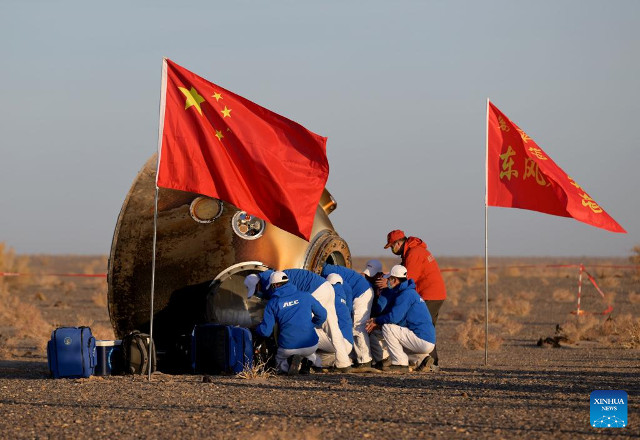
The Shenzhou 16 capsule after landing (Photo courtesy Xinhua/Li Zhipeng)

Yesterday, the three Chinese taikonauts of the Shenzhou 16 mission returned to Earth after spending 154 days on the Chinese Tiangong space station, landing at a site called Dongfeng in China’s Inner Mongolia Autonomous Region. During the capsule’s descent, some observers noticed a hole in the parachute. The speed of descent may have been faster than normal and the capsule toppled over after landing. It has already happened in the past that the capsule didn’t remain vertical and no consequences were reported for the taikonauts on board Gui Haichao, Jing Haipeng, and Zhu Yangzhu. In fact, there are no official communications regarding anomalies during the landing.

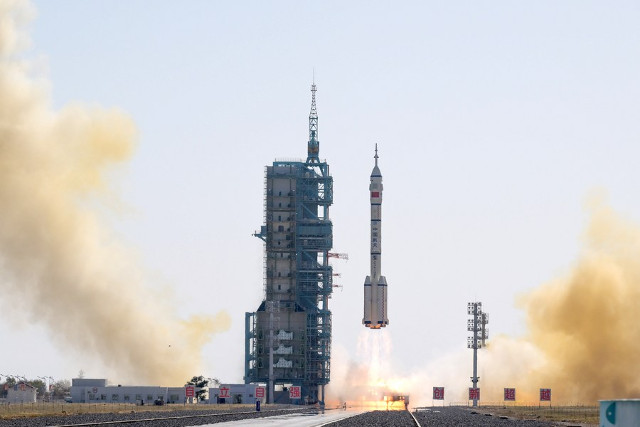
The Shenzhou 17 spacecraft blasting off (Photo courtesy Li Zhipeng)

A confirmation has arrived that three Chinese taikonauts from the Shenzhou 17 mission reached the Chinese space station Tiangong with an automated docking maneuver. They blasted off about 6.5 hours earlier atop a Long March-2F rocket from the Jiuquan Satellite Launch Center. They form the sixth crew of the Chinese space station and will remain there for about six months, the standard duration for a mission.

The three taikonauts, as the Chinese call their astronauts, of the Shenzhou 17 mission are Tang Hongbo, Tang Shengjie and Jiang Xinlin, whose names were announced only the day before the launch, as is customary for the Chinese.

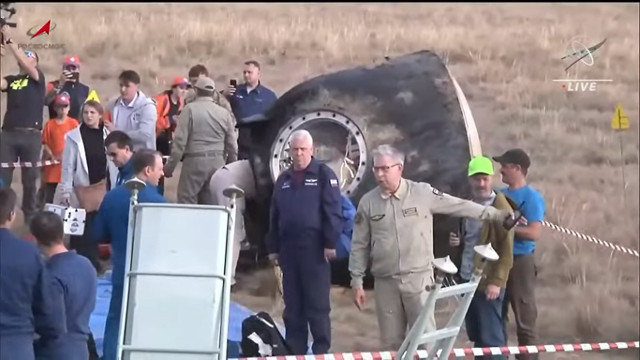
The Soyuz MS-23 Capsule after landing (Image NASA TV)

A little while ago, cosmonauts Sergey Prokopyev and Dmitri Petelin and astronaut Frank Rubio returned to Earth on the Soyuz MS-23 spacecraft, which landed in Kazakhstan. They spent just over one year on the International Space Station, where they arrived on September 21, 2022, as part of Expedition 67. According to the original schedule, they were supposed to spend about six months on the Station but the failure of the Soyuz MS-22 spacecraft led to to double their mission’s duration.

The Soyuz MS-24 spacecraft blasting off atop a Soyuz-2.1a rocket (Image NASA TV)

A few hours ago, the Soyuz MS-24 spacecraft was launched from the Baikonur Cosmodrome in Kazakhstan and after a little more than three hours reached the International Space Station with three new crew members on board. It docked with the Station’s Rassvet module. As is becoming increasingly common for crewed trips as well, the ultra-fast track was used which halves the journey duration.

Oleg Kononenko and Nikolai Chub will spend about a year on the International Space Station while Loral O’Hara will spend about six months there and return to Earth with different traveling companions. Expedition 69 is almost over, as in less than two weeks, the crew members who’ve been on the Station for a year will return to Earth marking the start of Expedition 70.