Cosmology

The eROSITA bubbles

An article published in the journal “Nature” reports the discovery of a gigantic structure formed by hot gas with a shape similar to that of an hourglass with lobes that extend from the center of the Milky Way. A team of researchers used observations conducted with eROSITA, one of the instruments of the Spektr-RG space telescope, which identified this structure at X-rays that is very similar to the so-called Fermi bubbles.

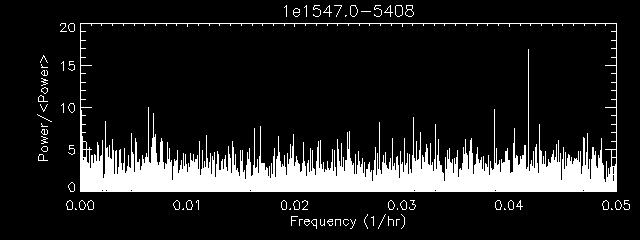
Emissions from 1e1547.0-5408

An article accepted for publication in “The Astrophysical Journal” reports a new analysis of observations conducted in 2009 of the magnetar cataloged as 1E1547.0-5408. A team of researchers led by GianLuca Israel of the Italian National Institute of Astrophysics in Rome used data collected by the Parkes radio telescope and NASA’s Chandra and ESA’s XMM-Newton X-ray space observatories to search for emissions from 1E1547.0-5408. The result was the discovery of strong close emissions of X-rays and radio waves that confirm a link between magnetars and fast radio bursts, the focus of recent research.

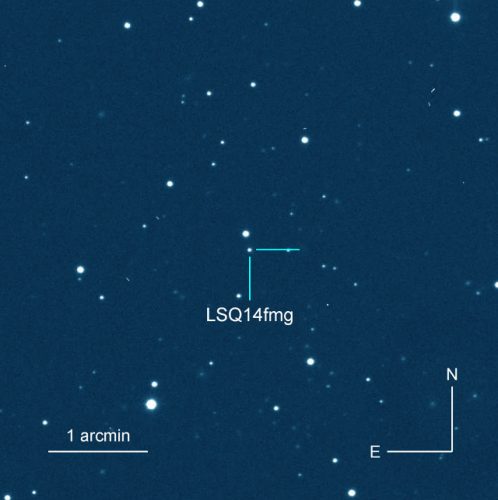
LSQ14fmg (Image courtesy Hsiao et al)

An article published in “The Astrophysical Journal” reports a study on the Type Ia supernova cataloged as LSQ14fmg, which became bright with considerable slowness but at some point became one of the brightest in its class. A team of researchers led by Eric Hsiao of Florida State University used observations conducted with telescopes in Chile and Spain to study its evolution. The conclusion is that the supernova was exploding inside what was an asymptotic giant branch (AGB) star and was caused by the merger of its core with a white dwarf orbiting inside it.

Artist's concept of black dwarf star (Image Baperookamo)

An article published in the journal “Monthly Notices of the Royal Astronomical Society” reports a research on the possibility that in a very distant future, estimated in 10^1100 years, even black dwarfs might explode in supernovae. Matt Caplan of the University of Illinois studied the models of white dwarf evolution as they will keep on cooling while pycnonuclear reactions, which occur at low temperatures but very high density, will generate iron-56. In quite a long time, even elementary particles will start decaying, and this will cause the explosion of the most massive black dwarfs, with masses between 1.2 and 1.4 times the Sun’s. It could be the last significant natural event in the universe.

The galaxy NGC 4414 (Image University of Oregon)

An article published in “The Astronomical Journal” reports a calculation of the universe expansion rate based on the so-called Tully-Fisher relation, an empirical relationship between the intrinsic brightness of a spiral galaxy and its asymptotic rotation velocity. Professor James Schombert, Stacy McGaugh, and Federico Lelli used the accurate distances of 50 galaxies as a guide to measure the distances of 95 other galaxies and then use those measurements to obtain a measure of the so-called Hubble Constant which has a peak of probability at 75.1 kilometers per second per megaparsec. This measure is very different from those obtained with other methods and, as a consequence, indicates that the universe is approximately 12.6 billion years old compared to approximately 13.8 billion obtained from other research.