
Cosmology

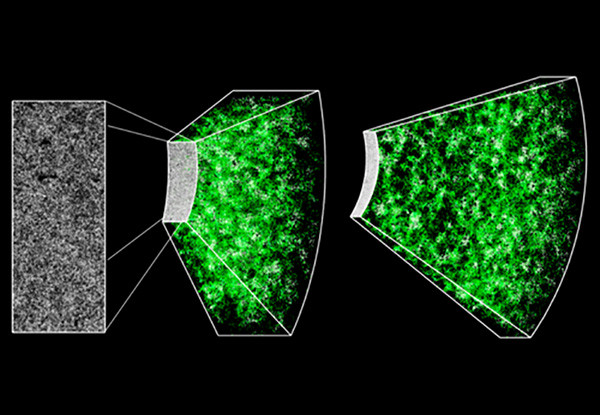
A section of the three-dimensional map of the galaxies of the Sloan Digital Sky Survey used for the analysis

An article published in the journal “Physical Review Letters” reports a new estimate of the expansion of the universe based on the large cosmic structures formed by galaxies. A team of researchers led by Dr. Seshadri Nadathur of the British University of Portsmouth’s Institute of Cosmology and Gravitation (ICG) used data about over one million galaxies and quasars collected over a decade by the Sloan Digital Sky Survey to create an analysis that provided a measure of the effects of the mysterious dark energy that’s accelerating the expansion of the universe. Adding a new method of its calculation doesn’t necessarily lead to the right value, but can help understand why other methods provide incompatible results and where we might need to expand our knowledge of physics to obtain the right value.

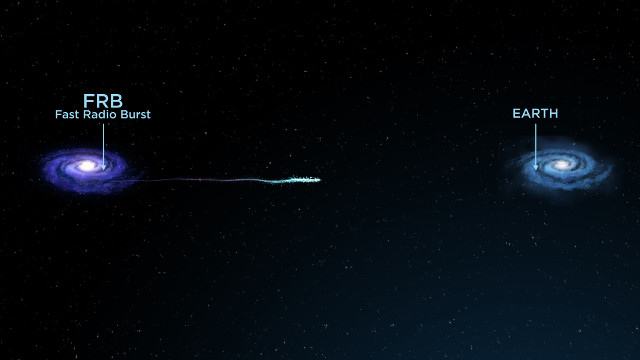
An FRB's journey to Earth (Image courtesy ICRAR)

An article published in the journal “Nature” reports a measurement of the amount of the so-called baryonic matter, ordinary matter, in the universe analyzing the characteristics of fast radio bursts (FRBs). A team of researchers led by Professor Jean-Pierre Macquart from the Curtin University node of the International Centre for Radio Astronomy Research (ICRAR), used detections carried out using the ASKAP radio telescope, which allowed to determine the position of the FRBs in the galaxies that host them with considerable precision. By analyzing their characteristics it was possible to determine the density of matter between their point of origin and the Earth.

Artist's concept of the two massive black holes in the OJ 287 galaxy (Image NASA/JPL-Caltech)

An article published in “The Astrophysical Journal Letters” reports observations of a supermassive black hole passing through the disk of materials surrounding another object of the same type but even more massive in the galaxy OJ 287. A team of researchers used NASA’s Spitzer space telescope to monitor this event, which was predicted by a model created specifically to take into account the extreme environment generated in particular by the larger of the two black holes, whose mass is estimated at around 18 billion times the Sun’s. This model, from 2018, is the most recent and takes into account gravitational waves but also the no-hair theorem.

A screenshot from a simulation of an event such as GW190412

An article published on the arXiv server reports the observation of gravitational waves emitted by the merger of two black holes with very different masses. The scientists from the LIGO and Virgo collaborations used the data collected by their detectors to examine this merger, the first in which the mass of the two objects is so asymmetric given that the estimates made indicate that they were 8 and 30 times the Sun’s. The event, cataloged as GW190412, produced waves with shapes different from those found so far in mergers between objects of similar masses and contain information that allowed to obtain more precise measurements of the pair’s physical properties. It also made it possible to conduct new tests of the theory of general relativity, confirmed once again.

Eros Vanzella indicates the Lyman-Alpha emission region measured with the MUSE instrument (Photo courtesy Eros Vanzella / INAF. All rights reserved)

An article published in the journal “Monthly Notices of the Royal Astronomical Society” reports the discovery of primordial stars that could belong to the so-called Population III, the first generation of stars in the universe. A team of astrophysicists led by Eros Vanzella and Massimo Meneghetti of the Italian National Institute of Astrophysics, Bologna, used data collected with the MUSE instrument mounted on ESO’s VLT and a powerful gravitational lens generated by the galaxy cluster MACS J0416.1-2403, or simply MACS J0416, to obtain magnified images of stars that seem free of metals and composed only of hydrogen, helium and traces of lithium.