Cosmology

Origin of a non-repeating fast radio burst pinpointed

An article published in the journal “Science” reports the localization of the point of origin of a non-repeating fast radio burst. A team of researchers led by Keith Bannister of CSIRO (Australia’s Commonwealth Science and Industrial Research Organization) discovered the fast radio burst cataloged as FRB 180924 with the ASKAP radio telescope and then proceeded using the Keck, Gemini South and VLT telescopes to pinpoint its origin in a galaxy about 3.6 billion light years away. Before this result, only the origin of a repeating fast radio burst was pinpointed.

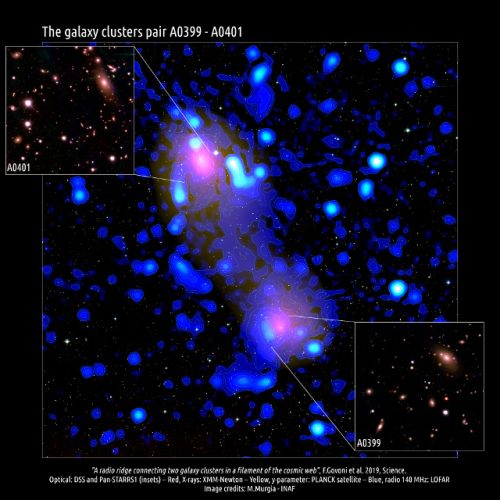
A cosmic aurora between the Abell 0399 and Abell 0401 galaxy clusters

An article published in the journal “Science” reports the identification of electromagnetic fields along a filament that crosses the approximately 10 million light years between the Abell 0399 and Abell 0401 galaxy clusters. A team of researchers led by Federica Govoni of the National Institute of Astrophysics, Cagliari, used the Low Frequency Array (LOFAR) radio telescope to carry out for the first time measurement of such a structure in radio waves.

New clues to the origin of fast radio bursts in neutron stars

An article published in the journal “Astronomy & Astrophysics” reports a study of the data about 43 fast radio bursts (FRBs) that offers new clues to their origin in neutron stars. A team of Italian researchers associated with the National Institute of Astrophysics used observations made with the ASKAP and Parkes radio telescopes, adapting a test from the 1960s to try to establish their distribution by comparing it with that of stars. The results gave some surprises and are not conclusive, but a method was offered that could be the key to solving the mystery for good.

The unexpected brightness of the earliest galaxies in the universe offers clues to a crucial moment in its evolution

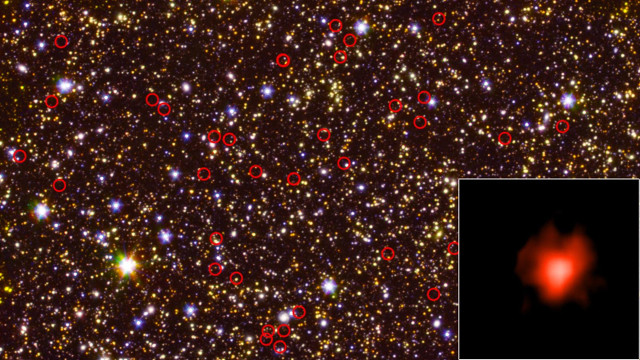
An article published in the journal “Monthly Notices of the Royal Astronomical Society” shows evidence that the oldest galaxies in the universe were brighter than expected. A team of researchers combined observations made with the Hubble and Spitzer space telescopes of galaxies that formed less than a billion years after the Big Bang and discovered an unexpected infrared brightness. That’s the consequence of the release of ionizing radiation and that can offer new clues to the epoch of reionization, a crucial moment in the history of the universe.

The extent of the expansion of the universe is increasingly precise and stresses the discrepancy between the measurements

An article published in “The Astrophysical Journal” reports a new measurement of the expansion of the universe, which is approximately 9% faster than the estimates made by studying the early universe. A team of astronomers led by Nobel laureate Adam Riess combined observations made with the Hubble Space Telescope of 70 variable stars called Cepheid variables used for measurements with others conducted by the Araucaria project to obtain extremely precise measurements of their brightness. The discrepancy between the measurements of the expansion of the near universe and those of the early universe remains and it’s important to improve the measurements to obtain clues to the origin of the discrepancy.