
Cosmology

GRB 161219B and its echo

An article published in the journal “Astrophysical Journal” describes the study of a sort of echo generated by a gamma-ray burst cataloged as GRB 161219B emitted by a newborn black hole. The gamma-ray emissions lasted only seven seconds but emissions at other electromagnetic frequencies lasted even for weeks, which enabled a team of astronomers to use the ALMA radio telescope to study the ones at millimeter wavelengths. They offered other information on the gamma-ray burst and on the characteristics of its powerful jets.

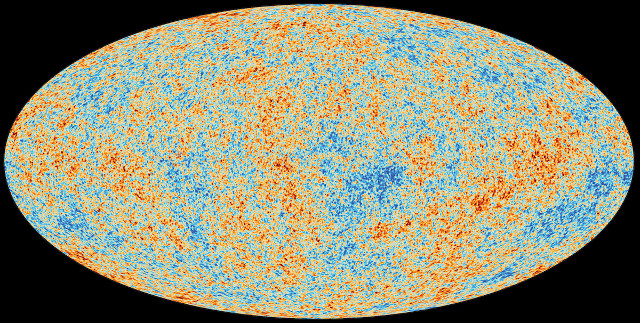
CMB Final Map (Image ESA/Planck Collaboration)

ESA presented the final map of the cosmic microwave background radiation created thanks to the Planck Surveyor space probe. This map shows what the universe was like before galaxies formed when it was about 380,000 years old. These are the results of the last processing of the collected data and now scientists are certain that the temperature and polarization are accurately determined. This final map confirms the standard model but also the inconsistency between the calculation of the Hubble constant based on those data and the one based on observation of the current universe.

Scheme of Hubble and Gaia at work (Image NASA, ESA, and A. Feild (STScI))

An article published in the journal “The Astrophysical Journal” describes a new measurement of the expansion of the universe. A team of astronomers led by Nobel Prize winner Adam Riess combined observations made with the Hubble Space Telescope and those made with ESA’s Gaia space probe, an observatory that specifically aims to map billions of objects in the sky including the variable stars called Cepheid variable used for those measurements. The new results increase the accuracy but also the discrepancy between the measures of the expansion of the near universe and those of the early universe.

Artist's concept of the blazar OJ 287

An article published in the journal “Monthly Notices of the Royal Astronomical Society” describes a research on a blazar, a type of active galactic nucleus, known as OJ 287. A team of researchers led by Silke Britzen of the Max Planck Institute for Radio Astronomy (MPIfR) in Bonn, Germany, studied this blazar, which has long been known and left the astronomers puzzled by its variations in brightness. The cause could be in the presence of two black holes or a misaligned accretion disk.

The galaxy ESO325-G004 and the Einstein ring (Image ESO, ESA/Hubble, NASA)

An article published in the journal “Science” describes the most precise verification of Albert Einstein’s general theory of relativity outside the Milky Way. A team of researchers led by Thomas Collett of the Institute of Cosmology and Gravitation at the British University of Portsmouth used data collected by the Hubble Space Telescope and ESO’s VLT to observe a gravitational lensing effect, one of the relativistic predictions, created by the galaxy ESO325-G004. The two instruments provided separate data that, compared, confirmed the correctness of the theory.