Cosmology

Scheme of the detection of baryons in intergalactic gas

An article published in the journal “Nature” describes the discovery of the missing ordinary matter in the universe. A team of researchers led by Fabrizio Nicastro of INAF, Rome, Italy, discovered what is technically called baryonic matter after having searched it for almost twenty years using ESA’s XMM-Newton space telescope keeping under observation the quasar 1ES 1553+113 up to find the traces of the baryons hidden in the hot gas present among the galaxies.

GW170817 seen by XMM-Newton (Image ESA/XMM-Newton; P. D'Avanzo (INAF–Osservatorio Astronomico di Brera))

Two articles, one published in the journal “Astronomy and Astrophysics” and one in “The Astrophysical Journal Letter”, describe two researches on the consequences of the merger of two neutron stars detected last year at electromagnetic and gravitational waves. ESA’s XMM-Newton space telescope was used to monitor the evolution of its X-ray emissions. NASA’s Chandra X-ray observatory was similarly used and a team of researchers concluded that the merger generated a black hole.

Artist's concept of PSR J2215+5135 irradiating its companion (Image courtesy G. Pérez-Díaz/IAC)

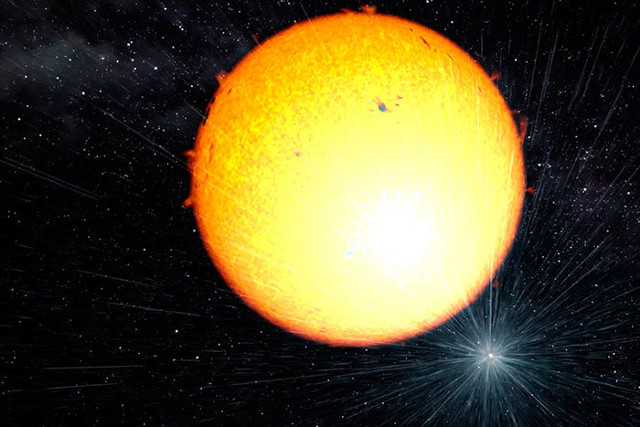
An article published in “The Astrophysical Journal” describes the study of a pulsar cataloged as PSR J2215+5135 which is extreme even for this category of objects. A team of researchers from the Universitat Politècnica de Catalunya (UPC) and the Canary Islands Institute of Astrophysics (IAC) used an innovative method to measure the mass of one of the most massive neutron stars discovered, estimated in 2.3 times the Sun’s. This is a method that can also be used with other objects.

the W43-MM1 area (Image courtesy ESO/ALMA/F. Motte/T. Nony/F. Louvet/Nature Astronomy. All rights reserved)

An article published in the journal “Nature Astronomy” describes a research on a region of space about 18,000 light years from the Earth in which a remarkable star formation is being observed, cataloged as W43-MM1. A team of researchers used the ALMA radio telescope to study it and found that more massive stars are forming than predicted by current models.

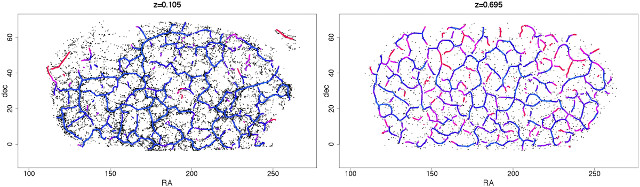
The cosmic web in two moments

An article published in the journal “Nature Astronomy” describes the creation of a map of the network of filaments that connects matter all around the universe. A team of researchers analyzed the data collected during previous surveys to find the gravitational effects that reveal the shapes of those filaments. Those small gravitational distortions suggest that they’re hundreds of millions of light years long and that they’re made of dark matter.