Cosmology

Scenarios after the kilonova (Image NRAO/AUI/NSF: D. Berry)

An article published in the journal “Nature” describes a research on the consequences of the merger between two neutron stars observed in the emission of both electromagnetic and gravitational waves. A team of researchers led by Kunal Mooley of the US National Radio Astronomy Observatory (NRAO) used the Very Large Array (VLA) together with the Australia Telescope Compact Array and the Giant Metrewave Radio Telescope in India for three months from the beginning of September to detect the radio waves emitted by the event at the origin of the gravitational waves recorded on August 17, 2017 in the event labeled as GW170817.

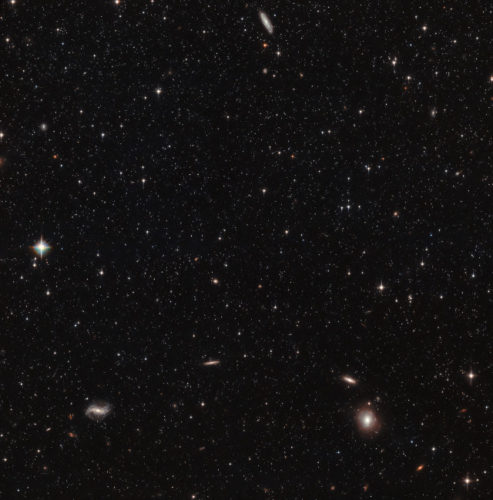
A part of the Sculptor Dwarf Galaxy (Image ESA/Hubble & NASA)

An article published in the journal “Nature Astronomy” reports the reconstruction of the 3D movements of 10 stars in the Sculptor Dwarf Galaxy selected within a larger sample of over 100 among those with the smallest measurement errors. A team of researchers used observations made using the Hubble Space Telescope in 2002 and subsequent observations carried out by ESA’s Gaia space probe between 2014 and 2015 to produce this reconstruction that confirms the “cold” dark matter model.

Representation of neutrinos reaching IceCube (Image courtesy IceCube Collaboration)

An article published in the journal “Nature” describes the measurement of the probability that neutrinos will be absorbed by Earth depending on their energy and the amount of matter they pass through. The researchers of the IceCube Collaboration used the neutrino detector in Antarctica to better understand the behavior of these elusive particles.

The galaxy NGC 4993 seen from several different ESO telescopes (Image VLT/VIMOS. VLT/MUSE, MPG/ESO 2.2-metre telescope/GROND, VISTA/VIRCAM, VST/OmegaCAM)

Yesterday ESO and LIGO/VIRGO collaboration held a press conference to present the results of a complex research that led to the discovery of the merger of two neutron stars observed in the emission of both electromagnetic and gravitational waves. These findings were collected in a series of articles that were published or will be published in the magazines “Nature”, “Nature Astronomy”, “Astrophysical Journal Letters” and “Physical Review Letters”.

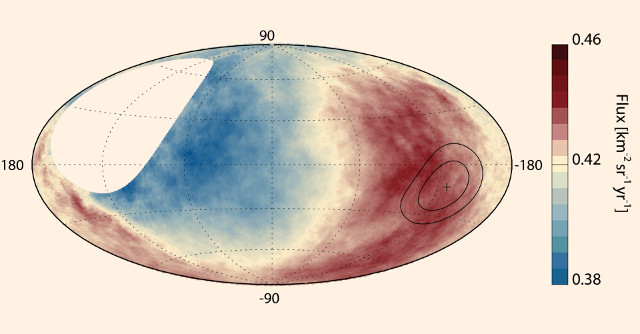
Map of cosmic ray flux (Image courtesy Pierre Auger Collaboration)

An article published in the magazine “Science” describes a research on the distribution of cosmic rays’ arrival directions. The Pierre Auger Collaboration used data collected by the Pierre Auger Observatory, Argentina, the largest ever built to detect cosmic rays, to find evidence that high energy cosmic rays come from outside the Milky Way.